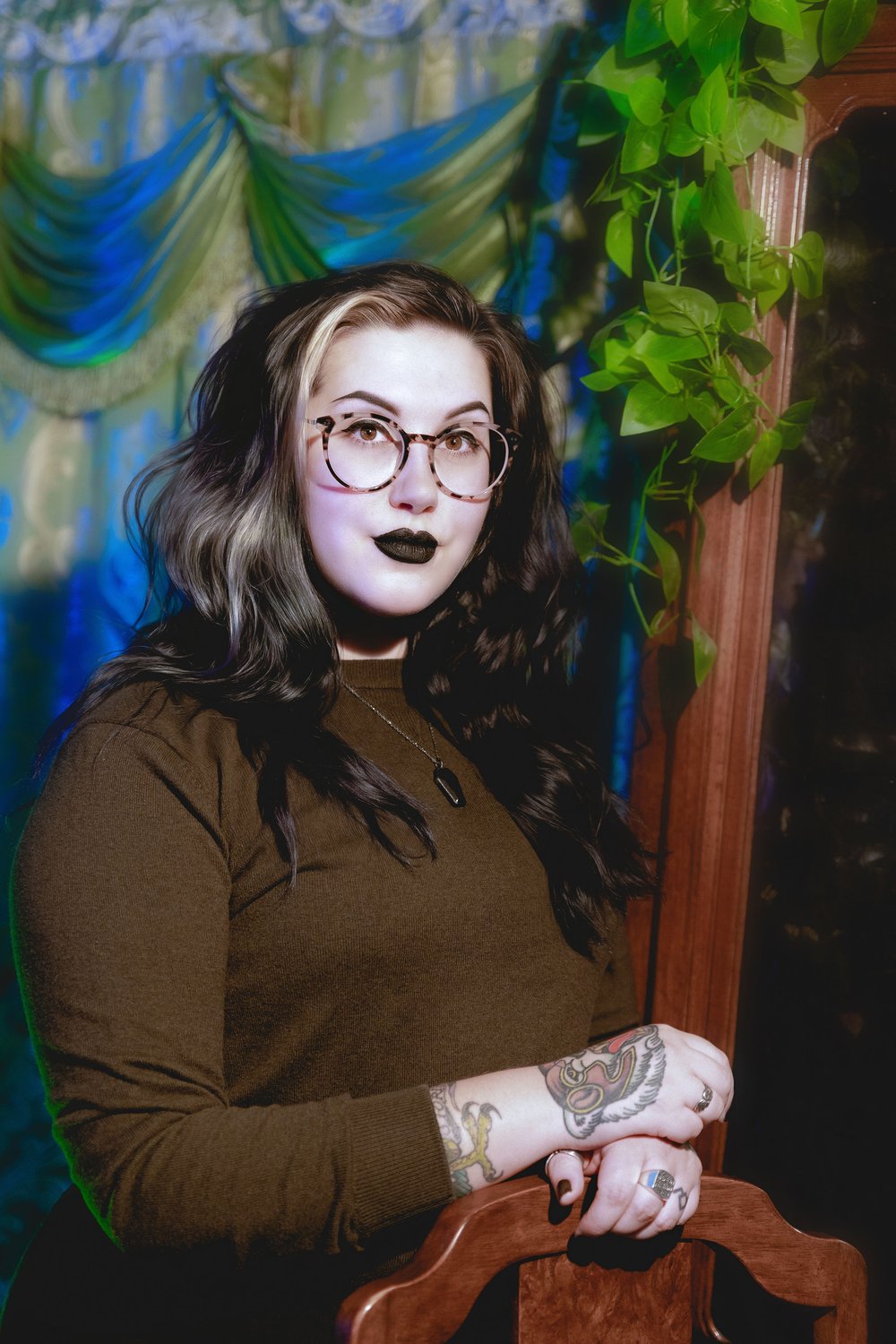
The Friends of the Idyllwild Library is hosting a talk with nationally recognized author and recent Idyllwild transplant Mallory O’Meara at 6 p.m. Tuesday, June 13 at the library.
O’Meara came to California to work in the film industry, becoming a producer of horror films, before she found her voice as an author. Her first book, “Lady from the Black Lagoon,” made the LA Times bestseller list, and in 2019 won both the Southern California Independent Booksellers Association Award for Biography and the Rondo Classic Horror Award for Best Book.
PHOTO BY RAE MYSTIC
Reviews themselves became deep dives into the book’s subject, Millicent Patrick. Artist, Disney animator, actress and designer for Universal Studios, Patrick’s signature creation was the face of the “Creature from the Black Lagoon,” the only classic Hollywood monster to have been designed by a woman. Her participation in a publicity tour for that film led to her firing; the studio’s head of makeup was notorious for squashing the career to anyone “under” him who displayed talent or attracted attention, and Patrick did both. Patrick’s story was pushed into the depths of obscurity, and O’Meara’s task was like diving into a submerged shipwreck.
O’Meara’s next book, “Girly Drinks: A World History of Women and Alcohol,” moved from biography to broad survey. It is a scholarly and rollicking tour through humanity’s relationship with intoxicating beverages, from a female perspective. A recurring theme is that brewing has been, around the world and through history, women’s work, and women’s business. On every continent and in many eras, it has been a path for women to financial independence, and O’Meara shows us how time and again male lawmakers have taken that away or tried.
This month, her third book, “Girls Make Movies,” was released. An accessible guide for young readers, it explains the stages of filmmaking; development, pre-production, production and post-production, in a girl-friendly style that is bound to fast-track generations of future filmmakers.
This week the Crier interviewed O’Meara by Zoom.
TC: How did you find Idyllwild?
MO: I came here on vacation. This was the first place that my boyfriend and I had ever gone to on vacation together. We really loved it. When we were in deep lock-down, it was ’21, and we had been living in this one-bedroom apartment in LA together for the whole pandemic, we thought, “Why should we be spending so much money for such a small space that currently we can’t enjoy?” He used to be a documentary film producer, now he’s also a full-time writer. Neither of us needed to be in LA on a daily basis. We started looking further afield. My boyfriend got real lucky with the place that we’re in, in Pine Cove. He just happened to be the first guy to call. We fell in love with it. We’ve been here a little over two years now.
TC: It’s different from Echo Park, huh?
MO: It sure is! Honestly, the biggest excitement for me was the opening of Speak Easy Books, having an “indie” book store up here that stocks so many new books, that is so curated, that sort of aligns with my political values. It just made me feel at home. And now there’s a gym; I really love going to Pharos. A lot of the things that make me feel at home in a town are opening up here. It’s beautiful; I had to go spend a week in LA recently, for a new book … I forgot how noisy it is! We really love it and want to stay.
TC: You mentioned the “Night on Bald Mountain” sequence in “Fantasia” as your childhood introduction to loving horror, but where did your love of books start?
MO: I had the same attraction and immediate draw to books as I did to monsters. My favorite picture of me as a kid, I think I’m probably 2 in the photo, and I’m holding an adult paperback novel, and it’s upside down, but I’m trying to read it. I’ve always been drawn to books; as objects as a kid, and as I started to grow up, stories. I don’t remember a time when I was without books or reading. I always wanted someone to tell me a story, and then as soon as I learned how to read, all I ever did was read. I was one of those kids that got in trouble for reading; at the kitchen table at dinner, reading in class under my desk. It’s such a part of my DNA I don’t know how I would separate “me” from books and reading.
TC: Your own path has had twists and turns; we read you were a monster fan studying to be a veterinarian, then a producer of monster films, biographer of Millicent Patrick and now a full-time historian.
MO: It’s been a weird journey.
TC: Was being a film producer a good preparation for being a researcher? In production you have to do a lot of hunting for things?
MO: And screaming. It was a great preparation for being a writer. And being a writer and being an author are two different jobs. There’s a lot of organization and people skills involved. Doing research you’re calling a lot of people, and you’re putting a project together. For me, writing is very technical: I’m taking a bunch of information and braiding it together in a way that makes sense to me. That’s what a film shoot is: tons of different people with different skills, and you’re putting them all together to make one big thing.
TC: That seems to be your calling, as a historian?
MO: Yeah, it’s what I love. I’m working on my next adult history book right now, I’m not allowed to talk about it. I really think that I’ve always been meant to be a writer, and I’ve tried to go in a different direction and life steered me back the other way. I love it so much, I love the act of writing, I love the act of research, I love being an author and being a reader. I’m thrilled that I am able to do it full-time.
TC: With research you tug on a thread and find a whole tapestry…
MO: Yeah, that is magic to me.
TC: Girly Drinks leads the reader into women’s history, which is world history.
MO: Yes, Girly Drinks was a really interesting project because it was so far outside of what I had done before. I’d been working in horror and film for so long. I would say that Girly Drinks is my “first book for normal people.” It was nerve-wracking for me entering that space and writing for people who didn’t know me … when I was writing “Lady from the Black Lagoon” I felt like I was talking to my peers; horror fans and monster fans. Girly Drinks was for a much different audience. Luckily the response has been incredible. We won the James Beard Award for it, which was unbelievable. It still has not sunk in to this day. That book cemented it for me, “I can do this, I can be a history writer.” I’m so grateful.
TC: “Geek” is a word that has changed meanings. It was an insult, then a new generation owned it as meaning there was some special area, and that you had gone from being a fan to knowing as much as possible about it.
MO: Being a geek has definitely been reclaimed. It’s a word that people very proudly use about themselves.
TC: “Monster” is also double-edged sword. It stops you in your tracks, but we can say “you are a monster of diligence.”
MO: It’s always been an interesting word, a loaded word. I think people who love monsters are people who are on the fringe. They are attracted to monsters and monster movies and comics for a reason: they feel a little bit different. Especially nowadays with the massive rise of social media, being different has become a thing that people are really proud of. People don’t want to be “normal” anymore; they are happy to be weird, to be geeks, to be monster nerds, it’s a beautiful thing.
TC: “Badass” is another key word. It rolls together competence, courage, talent and style.
MO: That’s the kind of women I write about. Millicent Patrick to me is the most badass person. I still have a huge photo of her in my office. She really means a lot to me; she was so tough. She taught me that you don’t have to dress a certain way to be badass. She could be badass in pearls and heels, and that was a huge revolution for my life.
TC: You had some thought-provoking words about the importance of women in horror films, how they embody vulnerability, how these films are “an exaggeration of their everyday lives.”
MO: It’s funny that people say women don’t belong in horror, but I’m like, “What do guys have to be afraid about?” When women are watching horror films, most have experienced those feelings, if not some of those situations. Who better to tell those stories?
TC: Your research seems to begin casually and grow into an obsession. What was the time scale for that?
MO: For “Lady from the Black Lagoon” it took three years. It was a long time. There was a lot of traveling. Girly Drinks would have taken longer but I was in lock-down. I started writing it in February of 2020. I had a lot of traveling that I wanted to do for it, but I had to stay in my one-bedroom apartment. There was a time period where I was pretty nervous; the library was closed, there was no way for me to do my research. Luckily, in about June of 2020, the LA Public Library opened for pickup. Those librarians really hated seeing me coming. It was always this massive, heavy box of books. I was really, really lucky that a few friends of mine, who will remain nameless, gave me their logins for various online archives, and between the two things I was able to write the book.
TC: We see you, in Lady, learning the ropes as a researcher. In the beginning you think of hiring a private investigator, and by the end you’ve found that librarians and archivists are like your PIs.
MO: They are also a lot cheaper. It wouldn’t have been the same; a huge part of what made the heart of that book was my search for her. Even though it took so long and was a grueling journey at times, I’m grateful that I did it. What better way to show that something had been purposefully hidden than to show how difficult it was to unearth? One jerk hid this woman’s legacy for 60 years. That one jerk made three years of work for me. I really wanted to bring people along on that journey.
TC: Uncovering the misogyny and sexism that beset Millicent was made difficult by misogyny and sexism; people said she wasn’t important, you won’t find anything, don’t bother …
MO: Oh yeah. People still dismiss her. It’s the air we breathe, it’s the water we all swim in. Honestly, all the push back made me realize that there was something there. If she hadn’t done anything she wouldn’t have made people so mad. It wasn’t tangible proof but it was proof in my heart.
TC: With a subject who is scantily documented you end up having to write a “life and times.”
MO: For sure. She deserves to have her entire story told. Her story was so bonkers, so over-the-top. Her childhood at Hearst Castle (her father was the engineer), working at Disney, being a model, working at Universal, I had to put it all in there because it was so fascinating. I always call her the Forrest Gump of the 1950s. She was moving from industry to industry and meeting all these interesting people and doing all these interesting things.
TC: She crafted a public identity. She knew her strong points and her audience when she dealt with male reporters. In show business you’re allowed to be creative, to embellish, to show some skin or present yourself as royalty. It’s not like running for Congress.
MO: No, no! Honestly, it’s sad that she passed away before social media, because she would have been great at it. She honed her ability to craft an identity, craft a mask for herself and embody that. It’s funny that we give women so much crap for this, but John Wayne did the same thing. She was one of the best. It’s hard to top an Italian baroness.
TC: We see you struggle with the facts behind the legend. There’s a moment where you think, “Maybe I shouldn’t.”
MO: I really and truly believe that women are worth writing about even when they screw up, and I realized that if I didn’t include that stuff I would be judging her, just like I was afraid everybody else was. When you are a woman who’s famous, who’s a creator, there’s this idea that you have to be perfect. Pre-#MeToo, pre-2000s, you couldn’t show any weakness, you couldn’t show any pain. I think that’s wrong. I think we need to give people more grace. I ended up being very happy that I wrote about the hard parts of her life.
TC: Patrick was so resilient, there was so much heartbreak, and so much picking up the pieces.
MO: Yeah. She had a rough go of it. One of my wishes is that I could have somehow done this book 20 years earlier so she would have not just been able to see her story told, but see how much of an impact that she’s had on the world. She died thinking that no one cared about her. If she could see a mile-long line of fans wrapping around Monsterpalooza in Burbank wearing “Creature from the Black Lagoon” shirts and Metaluna Mutant hats, (Patrick created these aliens for “This Island Earth”) I think that would have changed the way she saw herself.
TC: I appreciated your skill at reading your audience, at knowing how much to explain about people and things that are unfamiliar, and doing it so that an insider will think, “Oh, I hadn’t thought about it like that,” and an outsider will say, “Oh, that makes sense.”
MO: It was very intentional that I explain, with all my books … When we did Girly Drinks, my editor used to be a cocktail writer, huge into cocktails. We did the first pass and there were certain things, like certain cocktail tools and terms that he was like, “I don’t think we need to explain that.” We had his assistant Grace Towery read it. She is not a cocktail person at all and she flagged a bunch of things, “I have no idea what this is, what this means, what this does …”
TC: And you’ve written for kids, that’s another audience.
MO: Yes, my first kids’ book, came out last week, which is really wild. I think it is the first-ever book about filmmaking aimed at young girls. After Lady came out, a lot of people were like, “Man, I wish I could give this to my kid.” That got me thinking, and there was a project I had been working on, originally supposed to be for adults, but I thought, “I think this book will be better if it’s for girls.” That’s how “Girls Make Movies” came about. I co-created it with my friend and illustrator Jen Vaughn. It’s been a blast. There’s been this massive push to get more women doing everything in the world but especially in film; more female directors, screenwriters, but if we want that we have to build today, we have to build it with kids. I would have gotten into film five to 10 years sooner if I had known all the things that I talk about in “Girls Make Movies.” I didn’t know how movies were made even though I loved them so much. All of the books at the library about filmmaking were very intimidating, not welcoming to children, especially not welcoming to girls.
The book is my gift to myself when I was 11 years old. If I can’t go back in time to give myself that book, I will give it to 11-year-old girls now.
TC: What about the upcoming talk?
MO: They left it pretty open. The only thing they wanted me to talk about was “finding your voice as a writer,” which I’m very excited to talk about because, especially among historians, I have a pretty unique voice. I make jokes and I swear. It was definitely a process to find that in myself. With nonfiction writing it feels like there’s a lot of rules, especially with historical writing. It feels like there’s a certain way that you should do things, and now I know that there isn’t. So, I’m going to be talking about finding your voice as a writer and figuring out how to use that voice. I know that Idyllwild is filled with writers and creative people.