By Holly Parsons
Correspondent
An unprecedented nature experience sums up the allure of the Pacific Crest Trail (PCT). Each year between March and June, Idyllwild is the first major re-supply hub for migrating hikers from around the world. Beginning at the southern terminus (Mexican border), hikers journey north for 2,650 miles “beyond the pale,” into a world apart.
Partnership with nature’s elements of change and flow is essential to their dream of completion, whether it’s thru hiking or by section. Most hikers organically form trail families or “tramilyhs” for camaraderie, to share resources and offer safety. Yet, the commitment to skills training and practice hikes, plus trekking under the banner of “leave no trace” remains a daunting feat for most urban dwellers. This year 8000 permits were granted, not all start or finish – but the maximum permit allotment was reached, per Scott Wilkinson, PCT Association (PCTA).

PHOTO BY HOLLY PARSONS
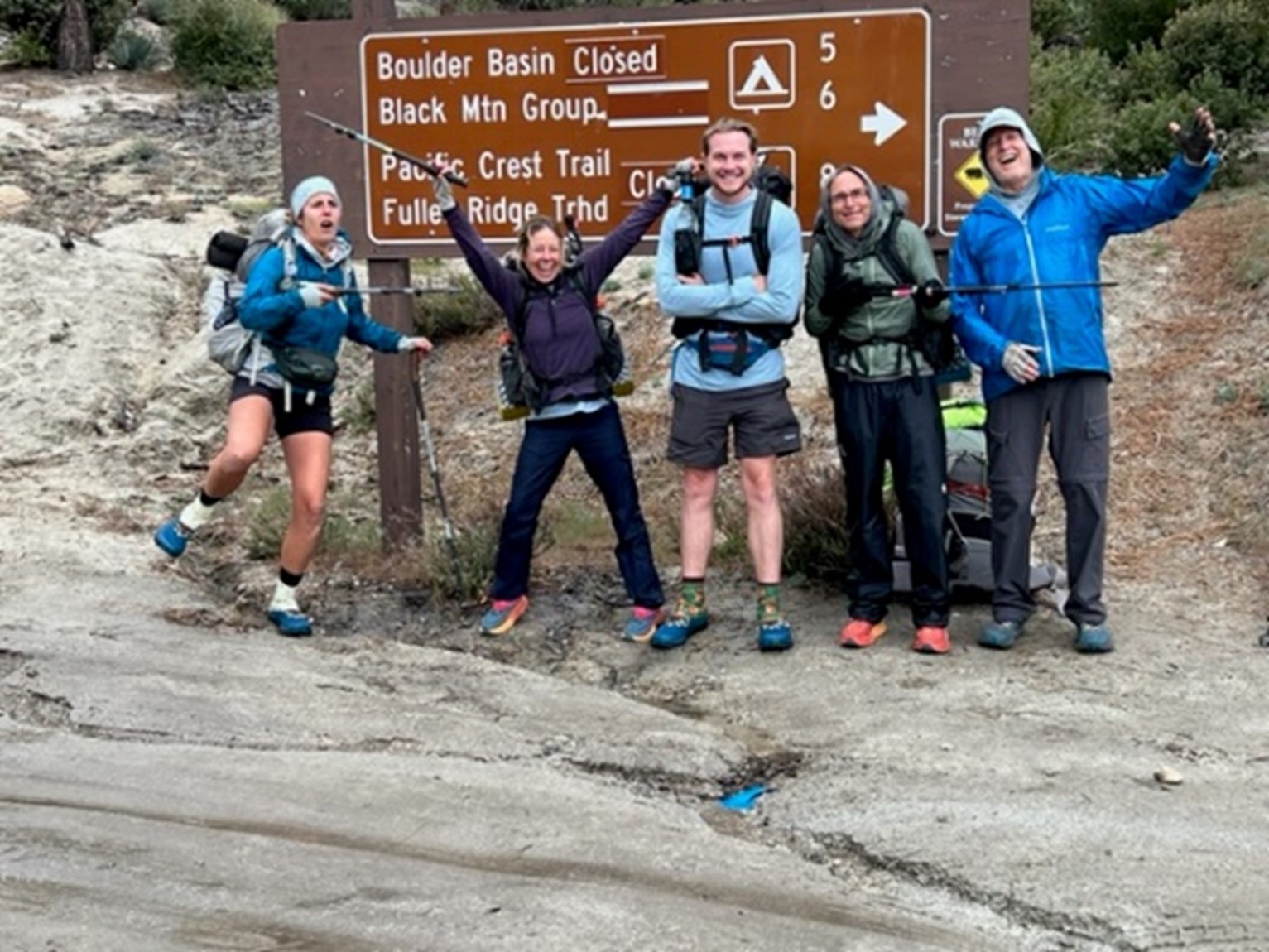
To deepen this understanding, I interviewed PCTA Board Vice-chair and Treasurer John Remmers as he passed through Idyllwild on his section hike through So-Cal Zone B. Originating from Warner Springs, Remmers descended into Idyllwild on the Devils Slide Trail.
Before he arrived here, after a zero — a day off the trail not hiking — he continued to Acton with hopes of less snow. Remmers completed the PCT from Acton to Kennedy Meadows before flipping to Warner Springs, a common strategy for 2023 thru-hikers trying to follow water and avoid snow.
Remmers, a lifelong hiker, has been a PCT section hiker since 1997. He said, “The first thing to understand is the PCTA Mission and Inclusion statements:
“The mission of the Pacific Crest Trail Association is to protect, preserve and promote the Pacific Crest National Scenic Trail as a world-class experience for hikers and equestrians, and for all the values provided by wild and scenic lands.”
I note the word “maintain” is missing. To this observation, Remmers replied, “The greatest misconception is that the PCTA runs the trail. In recent years there’s a backlog of blowdown.” Hikers in 2023 are decidedly challenged regarding trail maintenance. Hikers describe large numbers of dead and down trees creating arduous dangerous travel and the trail-markers can be difficult or impossible to find in snow without the benefit of compass and maps. The trail app Far-Out is a hiker’s main resource for social connections and maps on and offline, provided they have power.
PHOTO BY HOLLY PARSONS
On balance, the PCT’s 2,650 miles of trail through wild terrain is but a small part of the national trail system. Maintenance for national scenic trails is shared across multiple agencies such as Bureau of Land Management, National Parks, U.S. Forest Service and Bureau of Indian Affairs, who together service a total of 88,600 trail miles. “The PCTA supports trail maintenance by providing regional coordinators, crew leaders and trail repair volunteers,” said Remmers.
Also, the PCTA’s stated Commitment to Diversity, Equity and Inclusion is refreshingly transparent. In a nod to nature’s position in this regard, the PCTA draws a strong parallel. It states: “We believe that everyone deserves the opportunity to enjoy time outdoors. When people have meaningful experiences outdoors, their quality of life, health, and social well-being improve.”
Remmers added, “I am consistently impressed by the generosity of trail angels on the PCT from border to border who make it their business to support the legend. Community support is essential to sustain hiker success and Idyllwild is definitely an open-hearted outpost!”
To that end, the latest major development for U.S. hikers is TrailAngelCentral.org AKA TACO. Its charter is centralizing a national trail angel online resource to better connect hikers and angels for success. Created in 2022 by Scott Vanderlip and Alicia Lavigne aka Cookies and Sailor, the website is primarily resources for a more efficient way for hikers to find angels and angels to find hikers. Vanderlip and Lavigne discovered during their trail angel hosting activities and hiking parts of the PCT in summer of 2022 that the current methods by which hikers find angels and angels find hikers was very random and could benefit from more general organization or online lists of angels. I recently had the opportunity to spend time with their tramilyh in Idyllwild.
As an ultra-light hiker, Sailor’s grasp of trail and survival life is unparalleled; she sailed the open seas for 20 years and holds the distinction of Triple Crown for finishing all three major U.S. cross country treks. Cookies is an Information Technology (IT) professional and an active community organizer. Using his IT and website experience combined with his passion for community organizing, he could see how some simple online resources could easily help hikers and angels connect more efficiently.
In 2023, they created and outfitted a van that can be found parked at various key PCT hiker locations on the PCT trail this summer feeding hikers, gathering trail condition updates, and offering guidance, trail angel networking assistance and trail magic.
I asked Vanderlip why he set traditional life aside to support the vast community of cross-country hikers in this manner? He responded, “In my mind, it’s a fairly easy choice based on some simple human needs that trail angeling provides. For the trail angel, our giving provides human connection, conversation, and a sense of purpose and usefulness in our often-disconnected world. We are also assisting those with real life needs who show gratitude that feeds our hearts and souls.”
Regarding the trail I ask, “Is climate change affecting the PCT?” Remmers is quick to respond, “It’s one of our top issues. Trails are changing. When we project forward based on the recent past, weather trends become clear. We are acutely aware we need new tools, more tools, and more funding in the form of donations. Impacts facing all three major cross-country trails — Pacific Crest, Appalachian and Continental Divide — include trail maintenance largely degraded by fire, drought, snowpack, rain and flash flooding. The cumulative effect is especially evident this year on the PCT, where in some cases trails and bridges have washed out and water access has changed.”
“These factors also combine to evolve the changing nature of the PCT experience. It could be that section hiking over the course of several summers emerges as the obvious choice. The era of the thru hike for most, due to climate change, may be coming to an end except for the most experienced,” Remmers ponders.
“Water is also a concern,” said Remmers. “Angel Mary has offered a desert oasis water tank resource to hikers at mile marker 145.4 for over 10 years in Anza. The importance of her contribution to hikers can’t be overstated. Yet, last year her 550-gallon tank was stolen, value $15,000. She replaced it with a 65-gallon tank but has decided to retire and sell her property.”
“Putting the sad event behind her,” she states on her website. Remmers added, “Unless Mary’s shoes are filled, hikers next year will need to carry double the water.”
“What about preparation,” I ask? After speaking with dozens of hikers this year, some appear more star-struck than trained — and I’ve met and observed many more women on the trail than in past years. Remmers added, “Yes, we welcome new generations of hikers from all walks of life. Still, preparation is key.”
For the PCT we recommend courses in mountaineering and first aid at the very least,” advised Remmers. “For first-time hikers, read everything, and if a point shows up repeatedly, it’s probably true. Practice hiking in varying terrains and climates for a week, then two weeks with your equipment. Multiple kits targeting different terrains are basic requirements, one for desert, snow, mountaineering, and water needs are key to success and safety …
“Other courses in heat exhaustion, hypothermia and handling head injuries are also a good idea, as is ice axe training. Include an InReach sat[elite] locator device in your pack, it’s an essential tool. Research all equipment requirements extensively. Due diligence in this regard will make a huge difference,” adds Remmers.
What has surprised you most? “This year, U.S. high altitude and European alpine hikers — German, Dutch, Belgian and Swiss — crossed the Sierras first. Mountaineering experiences across Europe are hut-to-hut. These hikers are not accustomed to pitching tents in all manner of wind and weather conditions. Yet, their high-altitude mountaineering and cross-country snow training places them top of class. The PCT requires them to rough it … that’s the challenge,” Remmers continues.
“They will be followed by very experienced hikers. But hiker fall-out prior to reaching Canada needn’t be taken lightly. It’s the start that matters. Getting into wildlands and communing with nature provides a dimension unmatched by any other,” smiled Remmers.
I bade him farewell as he departed Idyllwild with his three-member tramilyh for the next chapter of their trek and recalled his sage advice, “Never hike alone.”
(This article was written without the use of AI.)