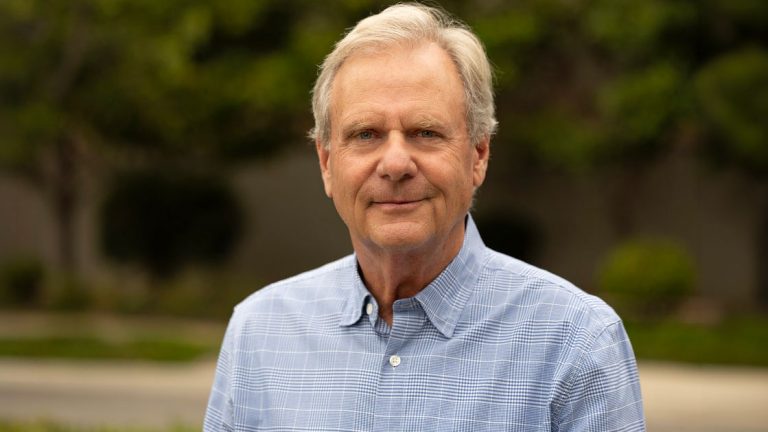
Wallis seeks re-election, déjà vu November 2022
Editor’s Note: The 2024 Presidential Election will be Tuesday, November 5. Besides the races for President and the U.S. Senate, to succeed Diane Feinstein, there are many local races which will determine who represents the Hill in the State Assembly and the U.S. Congress.
The Town Crier will be writing about the races for the U.S. Congressional District 41, California Assembly Districts 36 and 47, and the Idyllwild Water District.
The two candidates seeking to represent AD 47 are incumbent Republican Greg Wallis and Democrat challenger Christy Holstege (see the Oct. 3 issue to read the interview with Holstege).
California’s 47^(th) Assembly District encompasses Idyllwild, Pine Cove and north. It also includes the desert cities and Yucaipa and Yucca Valley in San Bernardino County. Valle Vista, Beaumont, and Banning are on the western edge of the District.
Greg Wallis (Republican – Rancho Mirage) represents California’s 47^(th) Assembly District. The Hill communities included in this District are Idyllwild, Pine Cove and north. It also encompasses the desert cities and Yucaipa and Yucca Valley in San Bernardino County. Valle Vista, Beaumont, and Banning are on the western side of the District.
Wallis was first elected in 2022. It was one of the closest races in decades. He defeated his Democratic challenger, Christy Holstege, by less than one percent of the vote, less than one-tenth of a percent. Wallis received 85 more votes than Holstege out of nearly 170,000 ballots casts.
This November, Wallis and Holstege are in a rematch. While Wallis is the incumbent, Democrats have a nearly 6% advantage in registered voters in the District.
“It was very close,” Wallis said. “In California we have election month, not election day. It was going back and forth for weeks as we kept looking at the counties’ updates” He admitted that it was only days before the final vote certification on Dec. 8, 2022, that he felt confident of victory.
When asked how he will retain the seat, Wallis replied, “That’s a valid question. I only won the last election by 85 votes. But the trend is toward the Republican positions.”
“And I believe good policy is good politics,” he continued. “For the last two years, I’ve been working for the entire District, making sure all voices are represented, not just a hyper-partisanship attitude.”
Stressing his bipartisan efforts, he noted that he was a member of the Legislature’s ‘Problem Solvers Caucus’.
“It’s bipartisan and bi-cameral,” he explained. “We focus on policy and work together. It’s my favorite.”
The major state issue is the budget. “Over the last ten years, it grown by more than $150 billion,” Wallis stated. “How many people tell you that government is doing a better job than ten years ago?”
He urges more legislative oversight of state programs. “It’s a spending problem, not a revenue issue.”
His example was the number of homeless people. In Sacramento, the success of these programs is often described in terms of how many people were added to the rolls. He argues that the metric should be how many people no longer need to be on the rolls.
Energy and housing, especially their costs, are the highest priorities for the District, Wallis opined and stressed that much of the housing costs are driven by legislative policies.
“Building in California versus any other state, is challenging. It’s more burdensome because of many environmental regulations such as CEQA [the California Environmental Quality Act],” he explained. “It delays building starts and the permitting process makes adds more time.”
All of California wants and deserves lean water and air, Wallis agreed. “But state policies are driving costs up. Zero free emission vehicles come with significant costs. And just look at your electric bill.”
The current special session on oil and gas prices and supplies disappoints him, also. Later the day of the interview, he returned to Sacramento for a vote on this legislation, which he opposed.
He was not prepared to support the proposed bill requiring refineries to keep fuel in storage in advance of maintenance shutdowns.
“This increases costs and does not increase supply,” he argued. “There is no pipeline bringing this fuel into California and we’re not drilling more.” He favors reducing the State gas tax.
Wallis supported the March Proposition 1 for homelessness and voted for many of the housing bills, which Gov. Gavin Newsom signed this month. “While we still have to make it easier to build houses, there are mental health and drug treatment programs which need to be operating.”
“I voted on the floor in support of Prop 1,” he said proudly. “The status quo is not working and we need to address the mental health and homeless problems.”
Wallis pointed out that the number of mental health beds in California today is about 5,000. In 1950, there were nearly 30,000. Prop 1 is the right approach.
Regarding November’s Prop 36, he favors its approval. “One of the biggest things Prop 36 does hold people accountable for actions. He noted that many individuals, who are homeless and commit a petty crime, can refuse drug treatment rather than incarceration.
“Under Prop 47, it became less desirable for folks to seek treatment. There was no push to seek treatment,”
Wallis’s wife, Desiree, is a teacher so he knows directly the value of education. But he stresses that not every student needs or wants to go on to a four-year college. High school curriculum should also prepare students for the workplace and trades.
“We need more career technical education programs,” he stated. “Both options – career and college—are important. While algebra is valuable, many students would benefit from financial literacy,”
While Wallis has not authored any legislation with national spotlight, he has successfully several bills that Newsom signed last month. These include Assembly Bill 2186 which clarifies that vehicles involved in sideshows or exhibitions of speed in parking lots are subject to the same impoundment laws as those on roadways.
“I grew up in the 90s. These illegal sideshows aren’t just disruptive; they’re deadly,” he lamented. “This bill makes it clear that reckless behavior, whether on the road or in parking lots, will face serious consequences. Innocent people can get caught in the crossfire.”
Three other bills addressed speed contests, sideshows and street takeovers, and the removal and impoundment of vehicles.
With respect to short-term rental issues, he would defer to local jurisdictions to oversee and regulate this problem. “The government closest to the people would know the best decision,” he offered.
But he was adamant that more forest management is necessary to reduce the threats of wildfires. He recently had a tour of a forest in the Shasta area and recommended that every legislator should be required to see it.
“We were shown the difference between a healthy forest and on overgrown. The dead and dying trees were allowed. This only increases fire intensity and it then goes into the forest canopy and spreads, threatening homes,” he noted.
“California will benefit from more balance in the Legislature,” he concluded. “There is a supermajority here and that’s no different than a super Republican majority in Tennessee. It is not good in either state.
“It’s important that all voters’ views are represented at the table. No party has a monopoly on solutions. We need to work with all viewpoints and constituents,” he averred.
Campaign finances
As of Sept. 24, Wallis’s re-election campaign fund had $546,000 in cash for the final month. Since Jan. 1, he had already spent $784,000. Since Sept. 24, nearly $175,000 more has been contributed to his campaign coffers.