Two high-ranking officers from Riverside Sheriff’s Office came to the Idyllwild Library on Sept. 19 at the invitation of Idyllwild Indivisible to speak to an audience of mostly skeptical locals about RSO’s use of Automatic License Plate Reader (ALPR) cameras. They were Walter Mendez, Captain of RSO’s Hemet Station, and Chief Deputy Ken Reichle.
Mendez explained that the Hemet station, including the Lake Hemet substation, is responsible for over 780 square miles. Its area of responsibility includes in addition to the mountain plateau communities of Idyllwild, Pine Cove, Mountain Center, Pinyon Pines, Sage, and Anza, much urban area: Valle Vista, parts of Hemet, San Jacinto to the Soboba reservation and casino, the Ramon Expressway corridor to Sanderson, 79 to Beaumont, the Domenigoni Parkway to Winchester, 60 to Moreno Valley, and 74 to Palm Desert. They have about 90 employees, 46 of them sworn deputies.
Mendez said about 100,000 people live in the geographic area the station covers, and the station receives about 32,000 calls per year, mostly from the urban area, with the number rising year over year. The “vast majority” of these calls, he said, are for theft including larceny, car theft and fraud.
Mendez said that the cameras are “very important” tools for solving crimes, and although most often used for car thefts, they are also used for a variety of violent crimes including homicides. “Before we were deploying these cameras we were averaging 800 to 900 arrests per year on these types of crimes. We’ve doubled it.” Later, one local asked about declining serious crime rates, and Reichle offered that one arrest often prevents multiple crimes.
Mendez also said that our community draws increasing numbers of visitors from a heavily populated geographical region, and the cameras are “a key piece of trying to stay ahead of the curve” with a larger volume of calls and limited staff. He called the cameras a “key piece of technology” and a “force multiplier.”
Mendez said that investigators must “parse” new types of information, including cell phone data and social media, while still respecting people’s rights, in order to prosecute cases. “Multiple cases, had it not been for this information, that lead, on a license plate….would not have been solved.”
He asked how many present had seen the show 48 Hours, and said he could not stress enough how accurate the show’s premise is, that investigators have a small window of time in which to capture information useful to solving a crime. The technology, Mendez said, allows investigators to look back in time purposefully. He added that ALPR cameras also help eliminate suspects, corroborating alibis.
The cameras have been in use since 2021, when the Riverside County board of supervisors approved a contract with Flock Safety Group Inc. The initial order was for about 260 cameras for the entire county. Reichle said that in Riverside County there are now close to 2,500 cameras.
At the end of 2023, Mendez said, they had 23 cameras within the Hemet station’s area of responsibility. Now the number is “close to 80.” It is hard to give an exact number, Mendez said, because “they keep breaking them, they keep stealing them.”
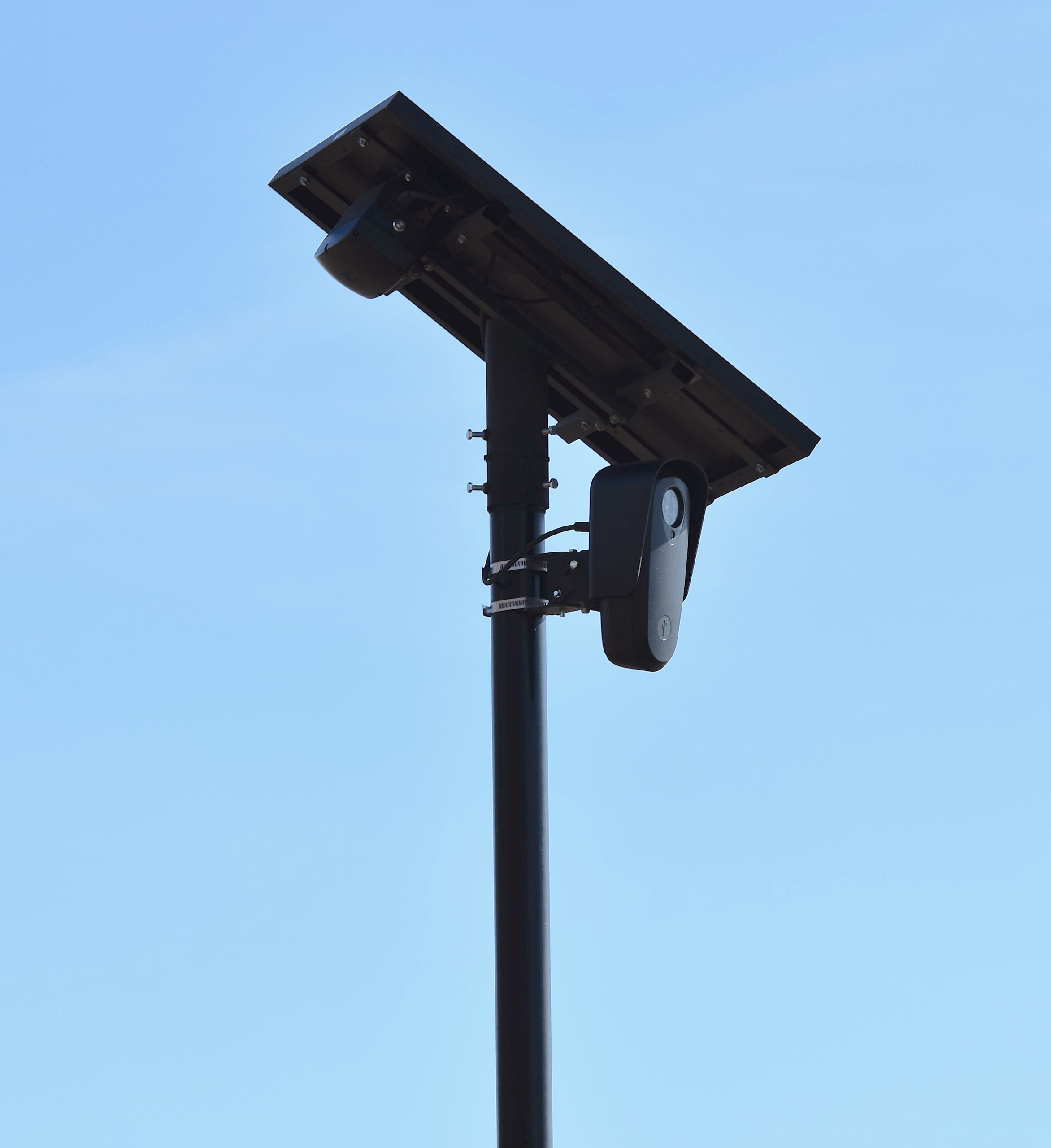
The cameras take photos of the back of passing vehicles. These are archived in a server, and can be searched by license number, make, model, color and other identifying marks like bumper stickers. The data is stored for 30 days.
Mendez described the process by which officers access and use the data. A deputy interviews a person reporting a stolen vehicle, taking down the make, model and license plate. “The officer or deputy involved still has to do their due diligence,” he said. The reporting party has to sign a stolen vehicle report under penalty of perjury, and the officers verify their identity and confirm that they have the legal right to report that vehicle stolen.
At that point the officer calls the dispatcher and gives his own identifying information and the file number of the case, asking that the vehicle be entered into the stolen vehicle system. That information is uploaded to the ALPR system, which sends it out to other counties. “If a suspect is driving three or four cities down… and it drives by one of those cameras, it captures a plate, we get what’s called a ‘hit.’”
If there is an ALPR reader hit, the officer is notified and units near the vehicle can then be informed and asked to pull a vehicle over. Sometimes, soon after a car is reported stolen, the reporting party finds out that a friend or family member has the car, and so officers tasked with pulling a car over must proceed with care.
One question was from a Hwy 74 commuter who said they had seen white vans making arrests near Paradise Corner, and asked whether the ALPR data is shared with Immigration and Customs Enforcement, Border Patrol or other federal agencies.
Reichle said that would be illegal, “I will go to jail if I share this information with the federal government.” California law prohibits sharing ALPR data with federal agencies.
Another asked about national reporting that ALPR reader data, in particular Flock data, is congregated and shared with Peter Thiel’s Palantir, which puts it into a database that is used by the federal government. Flock denies any relationship with Palantir, whose Gotham system is used by intelligence, military, and counterterrorism agencies as well as police departments.
Reichle said that RSO and the individual city governments with which they share data have contracts with Flock that state that the agencies own their own data and Flock cannot sell it. The information is shared throughout the state by law enforcement and certain other agencies like the DMV, but all those agencies are ordered by state law to not share with federal law enforcement.
Reichle also noted that the data is not shared with other states over concern that it might be used to trace women seeking abortions across state lines.
Reichle also explained that the data is kept “on the cloud,” meaning in a data center, which must be a government-compliant CJIS (Criminal Justice Information Services) facility. These are purpose-built for sensitive government data, he said.
One listener asked who decides where the cameras should be placed. Mendez said that RSO looks for high-traffic areas and primary entries to communities. Although our local highways are not high-traffic by urban standards, they are primary entries.
Reichle noted that RSO receives many reports of thefts of RVs, fifth wheels, and off-road vehicles on the Hill, in addition to, “believe it or not,” illicit marijuana grows. Mendez mentioned the 2020 mass homicide at one such grow in Aguanga. “You may not be seeing it, but there is a lot of activity that’s taking place up there,” he said. Aviation assets help locate these activities, Mendez added, but cameras identify vehicles and thus individuals.
Asked whether people who have cameras on their property are paid, Mendez said the cameras are typically on public land, sometimes on easements that may appear to be on private property. When asked about a local camera in Mountain Center, Reichle added that private citizens may purchase the cameras and deploy them and send the information to law enforcement.
Another question drew out a detail: Private parties that purchase the cameras and place them on private property, like a shopping center parking lot, may provide that information to the federal government or another third party.
Mendez jumped in on the mention of shopping centers, saying those parking lots attract thieves, and Reichle specifically pointed to Lowe’s, Home Depot, Ulta Beauty, Albertson’s and Stater Brothers as chains that keep these cameras in their parking lots, in trailers identified by flashing blue lights.
Yet another question was about officers using the cameras for their own purposes, typically tracking exes or “romantic interests.”
Reichle admitted that “we have that, just like anyone, police officers are humans too.” With 4,000 in the sheriff’s office, one has been fired and arrested and is in state prison, and two more are on administrative leave and under investigation, he said.
Asked how access is audited to ensure compliance, Reichle said that with all data access systems there is a “breadcrumb trail.” “I know who logged in, I know who accessed, and I know what they accessed,” he said. “We do audits monthly, and then the machine does audits.” Reichle credited the machine audits with catching misuse. “The way we’ve been able to capture our deputies being bad is through the AI tool.” The new tool flags unusual patterns, like a deputy searching for a car repeatedly. A supervisor reviews that and sees that it is unusual and starts an investigation.
The volume of requests for data makes the machine audits necessary, Reichle said. “Just last month, the CHP accessed our system 13,000 times,” adding that the Sheriff’s office is “learning as we go and trying to put up the guardrails.” “Before, it was a random sampling by a supervisor,” who had 80 officers who access the system hundreds of times a month. “There was not enough time in the day to police our police.”
The AI audit is, he said, “a much tighter system.” Access to the system requires a file number, and the AI quickly spots false file numbers. He said that with an audit of 4,000 officers making 50,000 uses of the system, finding three bad actors means that “most of them are doing the right thing,” and the sheriff’s office is “doing the right thing” by investigating and prosecuting those who abuse the system.
Another listener asked why, if the cameras are so great, are communities across the country deciding to remove them? Reichle replied that “if you really break down what is occurring, and you understand social media, how social media is used to change the perspective… they are coming out of the Defund the Police movement. We’re able to prove that these actors that are posting some of this stuff… are being paid for by some of the same people that were paying for the Defund the Police type movement.”
Mendez repeated that the ALPR data is just a tool for investigation, and that perhaps RSO should have done a better job of explaining their use “at the very onset.” Many members of the audience agreed with this. Reichle added, “there were tons of public meetings that nobody attended.”
Reichle mentioned the cost of hiring deputies, noting that the payroll and other costs total about $250,000 per year. The cameras cost about $3,200 per year each.
Asked about what would need to be done to defund the cameras, and whether there was a renewal coming up, Reichle said members of the public can comment on the subject at any Board of Supervisors meeting. He underscored that the supervisors and sheriff are elected officials, accountable to the voters.
After Reichle said that the county has a “good sheriff,” one listener asked if the rank and file of officers thought that was true, and Reichle affirmed that they did, and that he would be happy to argue Sheriff Bianco’s merits.
Reichle also expressed a willingness to come to Idyllwild or send a deputy whenever locals want to engage in a dialog about policing and the community.
Riverside County Board of Supervisors meetings are livestreamed and agendas are posted online.
Members of the public requesting to call in to speak on an item or during the public comment period must first register at the clerk of the board’s website, rivcocob.org/ 24 hours in advance. Once registered, further information will be provided.
Callers are requested to call in prior to 9:00 a.m. on the meeting date.