
|
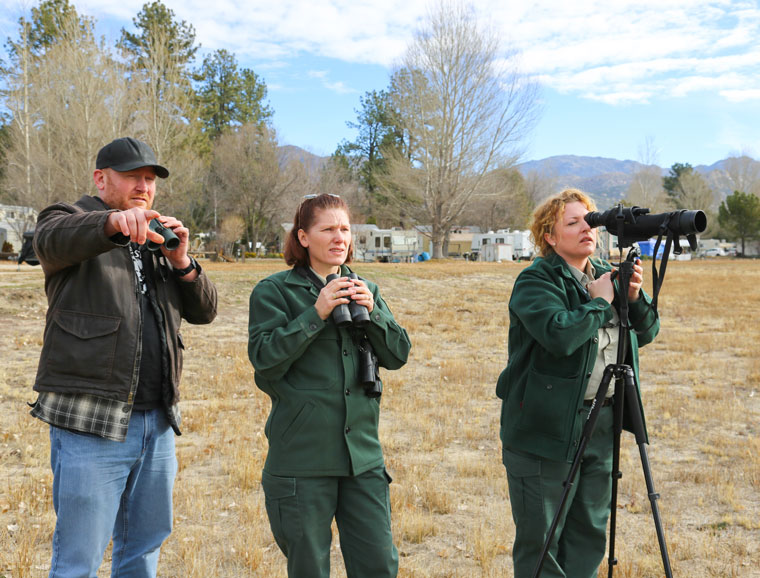
Through the help of volunteers, careful and vigilant eyes spotted two bald eagles by their nest during Saturday’s U.S. Forest Service bald eagle count. Charles Reinhardt is observing the eagles along with Heidi Hoggan (center) and LaReina Van Sant of the Forest Service. Photo by Cheryl Basye
Through the help of volunteers, careful and vigilant eyes spotted two bald eagles by their nest during Saturday’s U.S. Forest Service bald eagle count. Charles Reinhardt is observing the eagles along with Heidi Hoggan (center) and LaReina Van Sant of the Forest Service.
Photo by Cheryl Basye

During the second of four Saturday bald eagle counts, two adults were seen at Lake Hemet last weekend. A total of 13 bald eagles were seen in the San Bernardino National Forest on Jan. 10 during the count period, four more than the December count.

Public volunteers and U.S. Forest Service biologists again saw one adult eagle at Lake Perris and one at Lake Gregory. Observers counted four eagles (two adults and two juveniles) at Lake Silverwood. This count saw two adult eagles at Lake Arrowhead and three eagles (two adults and a juvenile) at Big Bear Lake.

The remaining bald eagle counts for this winter are scheduled for Saturday morning, Feb. 14 and March 14.  No experience is needed to participate in the counts.

Bald eagles are usually found close to water, such as Lake Hemet, because their diet is primarily made up of fish and ducks. As winter approaches in northern regions, lakes freeze over and waterfowl fly south. For bald eagles, that means the food they eat has become scarce. So, they head south looking for areas with abundant food supplies and end up wintering in Southern California, according to the Forest Service.

Breeding populations of bald eagles in Southern California were extinct by the late 1950s. Since 2003, several pairs of bald eagles have decided the Southern California neighborhoods were too nice to leave — they built nests and have successfully raised families. Nesting bald eagles can now be found at Lake Hemet, Lake Skinner, Lake Matthews and Big Bear Lake.

As the local populations continue to grow in North America, year-round residency and nesting is becoming more common.

A female eagle hatched at the San Francisco Zoo in 2000 was released as a chick on Catalina Island as part of the reintroduction efforts. In 2004, she arrived at Lake Hemet and decided to take up year-round residence with the male bald eagle already there. This pair has nested every year since then and fledged several eaglets over the past 10 years.

Future volunteers for the local count at Lake Hemet should meet at Lake Hemet Market at 8:30 a.m. for orientation. Contact Heidi Hoggan at hhoggan@fs.fed.us or 909-382-2945 for more information.

Similar Posts

  • GSOB in MAST hands

    In a sparsely attended meeting, the Mountain Area Safety Taskforce focused on the arrival of the Goldspotted oak borer on the Hill. The discussion addressed future actions, such as a census and mapping of the most vulnerable oak trees as well as potential protective actions and procedures for destroying infected trees. Riverside County Fire Department…

  • Another poultry recall

    By U.S. Department of AgricultureContributed Creative Food Processing, a Santa Clara, California establishment, is recalling approximately 1,941 pounds of raw chicken products due to misbranding and undeclared allergens, the U.S. Department of Agriculture’s Food Safety and Inspection Service (FSIS) announced. The product contains wheat, a known allergen, which is not declared on the product label….

  • Ruiz submits wildfire bill

    On Wednesday, Oct. 23, Dr. Raul Ruiz (D-36), along with three other congressmen, introduced legislation to authorize the Federal Emergency Management Agency to proactively coordinate with states and localities on wildfire mitigation projects. The Wildfire Prevention Act of 2013 (H.R. 3333) places wildfires on par with other natural disasters such as floods and tornadoes. The…

  • Scams will follow new COVID-19 rescue plan

    By Jennifer LeachAssociate director, Division of Consumer and Business Education The pandemic is still taking a toll on every kind of well-being we have. The new American Rescue Plan, just signed into law, gets the ball rolling to help out on many people’s financial well-being. Payments will soon be coming by direct deposit, checks or…