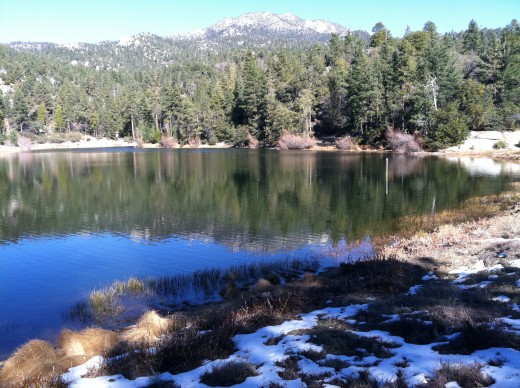
At the end of the Pine Cove Water District board meeting last week, General Manager Jerry Holldber reported on the status of a possibility that the Idyllwild Water District would transfer water from its proposed recycling facility to its Foster Lake reservoir.
“Several dozen customers have questioned me about what is going on,” Holldber said, explaining why he was reporting on the project. “And secondly, the lack of transparency. In 2010, I requested the plan and we’ve never received a copy. I’m concerned about non-potable water going into hard rock because of the way water travels through fractured rock. I’m still concerned of unknown risks or the chance of jeopardizing groundwater from putting non-potable water into Foster Lake.”
Although the State Water Resources Control Board approved grant money and loans for the construction of the project, another part of the agency has not approved the transfer of recycled water to Foster Lake and is now questioning IWD’s intent to pursue the project.
“We haven’t received anything on Idyllwild’s proposed recycled water-distribution system yet. The June 2016 report just had info on the proposed treatment plant and that Idyllwild wanted to use a tank at the [Idyllwild] Pines Campground to store recycled water in,” wrote Erica Wolski, associate sanitary engineer with the Recycle Water unit of the SWRCB. “We haven’t heard anything else since we gave them comments on the report in August. I’m not sure if they still plan to pursue the project now that management has changed.”
In early August, Wolski provided comments to IWD’s consultant on its latest report. Regarding the use of Foster lake to store recycled water, she wrote, “Above ground storage would be preferred to impoundments. Any impoundments proposed need to have an impermeable liner to avoid recycled water discharge to the aquifer.”
Questions over the use of recycled water near local wells have been raised before. In 2005, the San Jacinto Mountain Area Water Study Agency, which was a joint powers agency composed of Fern Valley, Idyllwild and Pine Cove water districts, had a contractor — Albert A. Webb Associates ¬— prepare a joint water management plan.
As part of the plan, the consultant assessed the possibility of a groundwater recycled reuse project. Webb and Associates contacted the state Department of Public Health and in March 2005, Steven Williams, the district engineer, replied to the questions about the “… the use of reclaimed secondary effluent from IWD wastewater treatment plan for ground water recharge.”
Since the three districts obtain most of their water from “wells drilled into this fractured rock aquifer,” the DPH was concerned about the lack of any studies or other proposed or operating groundwater recharge/reuse project in fractured-rock aquifer zones.
Consequently, any proposed project would have to undergo a thorough evaluation, according to Williams. “The project proponents must demonstrate, through modeling, tracer studies, or other means the ability to accurately predict and track the movement of any recharged recycled water once it leaves the recharge site.”
Holldber told the board he requested studies of this nature in 2010 and has not received any reports — final or draft —discussing how the water travels beneath the surface.
“Recycled water recharge with secondary treated wastewater effluent is prohibited and the project proponents would need to upgrade the wastewater treatment plant to an approved disinfected tertiary treatment process,” Williams concluded in his letter. IWD’s proposed recycling plant is a tertiary treatment process.
If IWD is prohibited from moving water from the recycling plant to Foster Lake, its success will depend largely on how much of the recycled water is used for irrigation. But that has a negative consequence on the district’s revenue, since recycled water cannot be sold for as much as potable water.
Earlier in December 2010, an internal IWD assessment deemed the project too costly for its limited purpose — reducing demand for potable water for irrigation use. But Webb and Associates had already opined that “the Idyllwild communities do not have a large number of heavily irrigated areas… and residential irrigation is seasonal.”
In 2012, the IWD evaluation assumed Idyllwild Arts would use 450,000 gallons for irrigation, and residents and commercial customers would use about 185,000 gallons. Ordinance 61 requires mandatory recycled water use for landscape irrigation.
Former IWD financial officer Jim Ludy reviewed the consultant’s report, which was sent to the state, and wrote, “This report is inaccurate and not in the best interest of the District or its customers.” The former boards never discussed this difference of opinion publicly.
In June 2012, the district dismissed Ludy for malfeasance. Ludy then sued the district. He contended his dismissal was because of his comments and review of the recycled water project. Less than two years later, IWD settled the suit.
Cost of recycling plant continues to grow
| 2013 estimate | $1.3 million |
| 2015 funding approval | $2 million |
In November 2015, after receiving funding approval from the SWRCB in the spring of 2015, IWD contracted with Separation Processes Inc. to develop specifications for the plant, called the preliminary design report. While these were expected within months, the final report has yet to go to the board. This may increase construction estimates.