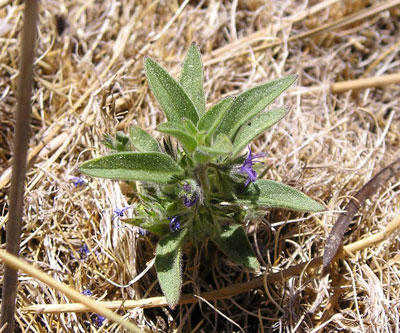
Photo courtesy the U.S. Fish and Wildlife Service
The Hidden Lake bluecurls have proven their resilience and perseverance. Last week, the U.S. Fish and Wildlife published a notice and requested comments on its proposal to remove the San Jacinto Mountain native flower from the endangered and threatened list.
The local plant, whose official name is Trichostema austromontanum ssp. compactum, was identified as a threatened species in September 1998.
Since then, multiple agencies, including the California Department of Parks and Recreation that manages the land where Hidden Lake, home to the bluecurls, is located, and the Rancho Santa Ana Botanic Garden, have monitored and studied the species.
Hidden Lake is a small montane vernal pool (fresh water marsh) within the San Jacinto Mountain State Park wilderness area, the only known habitat for the native bluecurls.
Last week, the published rulemaking stated, “Having considered the individual and cumulative impact of threats on this subspecies, we find that Trichostema austromontanum ssp. compactum is not in danger of extinction throughout all of its range, nor is it likely to become so in the foreseeable future.”
The Center for Biological Diversity, which had an office in Idyllwild, also praised the decision and success story. “The Endangered Species Act has saved yet another species from extinction,” Ileene Anderson, a senior scientist with the center wrote in a press release. “Thanks to this highly effective law, the beautiful Hidden Lake bluecurls will now be around for generations to come.”
The watershed area where the flower grows is now managed as a natural preserve to protect rare plants and wildlife. The U.S. Fish and Wildlife Service and the California Department of Parks and Recreation have developed a long-term monitoring and management plan to ensure the flower is safe into the future, the CBD added.
The 1998 decision was influenced by two major threats to the Hidden Lake bluecurls and the significance of both have been diminished or refuted in the past decade.
Hikers and equestrians were trampling the flowers. As a consequence, CDPR, which manages the lake and land surrounding it, has placed fences and moved a trail, considerably reducing the damage from this threat.
The latest review found that “trampling by humans has been minimized and no visible impacts to [the plant] have been observed from trampling by horses since 2000 because of CDPR’s management.”
“Southern California is home to numerous plants found nowhere else in the world,” Paul Souza, regional director for the FWS’ Pacific Southwest Region, wrote in the press release announcing the proposed delisting. “We appreciate the efforts of our partners to conserve the bluecurls and numerous other rare and endangered plants that maintain functioning ecosystems.”
Researchers also have learned that a small population is not an indicator of prevalent danger. The flowers produce seeds, but most seeds do not germinate in the next growing season. They are not pollinated by insects, but remain dormant, thus protecting the plants throughout environmental and climatic change.
For example, the bluecurl population size fluctuates greatly. It has grown from as few as 75 plants in 2000, to more than 240,000 in 2012 and nearly 60,000 plants in 2015. The scientists studying the plant concluded, “Despite these annual changes in size, the population is best characterized as stable because the variations are natural and tied primarily to the summer level of the lake.”
FWS, along with its partners, have determined that the state’s management of the San Jacinto wilderness area, and especially the Hidden Lake Preserve, has been very effective, the threat from stochastic events is much less than previously believed and an external seed bank also has been created.
A public hearing on the proposal will be scheduled. But comments on the delisting may be submitted to FWS on or before Monday, March 6.