Seeking aid for homeless and mental health issues
Editor’s note: The Hill is part of the 28th state Senate District. Jeff Stone, Republican from Temecula, is the incumbent. Joy Silver, of Palm Springs, is one of two Democrats challenging him.
Jeff Stone (Republican) is the incumbent state senator representing the 28th District, which includes all of the Hill communities. He is a former Riverside County supervisor, whose 3rd District also encompassed the Hill.
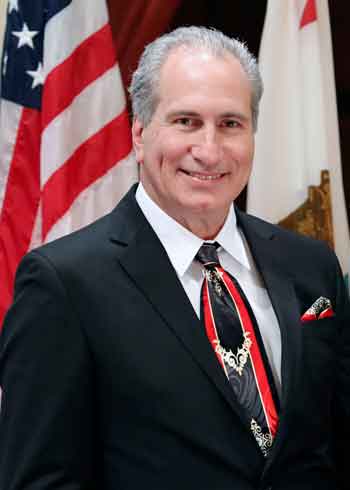
Photo courtesy John Hunneman
In June 2004, Stone defeated the incumbent supervisor. He was re-elected in 2008 and 2012 with more than 65 percent of the vote in each campaign.
In 2014, he set out to fill the vacant state senate seat and succeeded. He was the top vote-getter in the June primary and defeated fellow Republican Bonnie Garcia in the November general election.
The only defeat on his ladder was in 2016 when he challenged Congressman Dr. Raul Ruiz.
When asked how he compared the Senate to the Board of Supervisors, he said he enjoyed both positions, but for different reasons.
“In the Senate, we send money to the county to work on problems,” he said. “It’s a challenge and harder to fix. You need 20 people to pass a bill. On the board, you only needed two more to join you.”
In the Senate, which is a partisan body compared to the Board of Supervisors, Stone, as a Republican, is in the minority. Not only does he need 20 more senators to join him, but most of them will be Democrats.
And this situation is what he learned to overcome. As a senator, “I’m proud that I can work across the aisle,” he said. “I’m not afraid to do that.”
“One thing I don’t like is the partisanship [in Sacramento],” Stone stated. “I don’t like the label Republican or Democrat. They all are trying to improve lives.”
Demonstrative of this attitude is his support for Gov. Jerry Brown’s budget proposals. Stone agreed with Brown’s decision to put more of the growing revenues in the Rainy Day Fund.
He argued that elected officials are just as much public servants as executive employees, whether at the federal or state level. Washington, D.C. is very political.
Assuming he is one of the two candidates receiving the most votes, he expects the fall campaign to be much more competitive. Campaigns are for clarifying issues, not a personal attack on your opponent, he said. “Voters will get ideas and democracy will work.”
He also stated that he is proud that his “principles haven’t changed during all of his campaigns. I’m a businessman first.”
Throughout his political career, Stone has always said that public safety is “the number one responsibility of an elected official.
“My experience as a small businessman is just as important for government as an entrepreneur,” he stated.
As businesses leave California, he sees society coalescing into two classes — the poor and very wealthy. Almost 40 percent of the population is receiving some government assistance, he noted. “With unemployment at its lowest level, we shouldn’t have that.”
As a pharmacist, he understands the complexity and facets of healthcare issues. So, he challenged the legislative Democratic majority over support for mental-health programs.
“We’ve got problems out there,” he stressed. “Local government needs funding to help. People deserve help and to be treated humanely.”
With more than 100,000 Californians needing mental-health assistance, he is urging his colleagues to use $1 billion of the additional $9 billion in unexpected revenue for mental-health programs, such as job training for these individuals.
“The homeless need help. We’re driving middle class jobs out of California,” he lamented. “It’s appalling there are more homeless in Los Angeles than [the population of] some counties.”
Stone argued that counties are in the position to help these populations; however, “they can’t respond without funding. If counties had money, I believe they could solve the problem.
“These conditions shorten life span as much as 15 years. We have to fix this horrific problem. It’s an epidemic in the state,” Stone said plaintively. “It breaks my heart, and I know we can do better.”
Stone had submitted legislation to impose state income tax on part-time visitors, but he was quickly advised that many of these people spend the winter months in the desert and Coachella Valley.
He withdrew it and is revising the bill. “I want to go after the very wealthy — $20-, $40-, $100-million.” His goal is to help middle class families suffering from taxation.
So, Stone is looking forward to the summer and fall campaign. He does not consider it a luxury to have no challenger in a race. “I strive more and learn a lot from the campaign. I respect people who put themselves out there. It’s tough to take a position. It can tick some people off.
“I believe in what I’m doing, but an election is a progress report,” he concluded. “And the final report card is in November.”