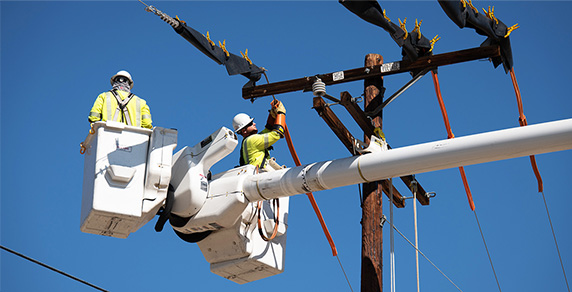
In early December, Southern California Edison (SCE), the largest subsidiary of Edison International, invoked a Public Safety Power Shutoff (PSPS) in the area. Most locations lost power by 9 a.m. Monday (Dec. 7) with power being restored to areas Tuesday evening. Power was not restored in Pine Cove until 11 a.m. Wednesday, Dec. 9.
At that point, many without generators threw out food from refrigerators and freezers.
Those with medical devices are put in a life-threatening position during these PSPS. SCE has a Critical Care Back-up Battery Program for those dependent on medical equipment for life-support services.
But here’s how you become “eligible:”
• Identified as a critical care customer through SCE’s Medical Baseline Program whose physician has verified on the application that they require medical equipment for life-support purposes and cannot be without power for more than two hours;
• Enrolled in SCE’s income-qualified California Alternate Rates for Energy (CARES) or Family Electric Rate Assistance (FERA); and
• Reside in a high fire risk area. (Idyllwild area qualifies)
Visit https://www.sce.com/residential/assistance/medical-baseline, for more information on the program and to apply.
These PSPS are done to reduce wildfires caused by power lines during inclement weather.
Pacific Gas & Electric (PG&E) continues to be hit with major lawsuits for the cause of the 2018 Camp Fire that killed 84 people, paying out $25 billion to date.
“The Camp Fire began in November after a suspension hook on a nearly century-old tower broke and caused a power line to fall and release sparks onto dry grass in the Sierra foothills,” according to a BBC report.
This year, SCE paid out a $1-billion settlement for its equipment sparking the 2017 Thomas (killed two people and destroyed more than 1,000 structures, courthousenews.com) and Koenigstein fires.
The Los Angeles Daily News reported Oct. 30, “A redacted version of the Woolsey fire investigation report obtained by the Ventura County Star concludes Edison equipment associated with an electrical circuit was the cause of the blaze two years ago northwest of Los Angeles.” The Woolsey Fire killed three people and destroyed 1,600 structures.
SCE provides service to approximately 15 million people over a 50,000 square mile service area that includes Southern, Coastal and Central California, including the Idyllwild area. As a comparison, Anza Electric Cooperative, Inc. began in 1955 and is a member of Touchstone Energy Cooperatives. The cooperative brings power to Anza, Garner Valley, Pinyon Pines and portions of Aguanga.
SCE customers have to spend money and plan for the next PSPS. The National Network has the following recommendations on its site: create backup power options compatible to the equipment, check the backup power regularly, teach neighbors and caregivers how to use the backup power system and operate equipment, keep instructions/serial and model number in a waterproof container with emergency supply kits and label equipment with name, address and phone number.
For those with life support devices, contact your local fire department, keep a resuscitation bag handy if you are a ventilator user and have a backup plan (with your doctor) for backup medical or dialysis treatment if PSPS impacts the facility. For oxygen users, avoid areas where there are gas leaks or flames, post “Oxygen in Use” signs, use battery powered flashlights or lanterns instead of candles or gas lights and keep the shut-off switch for oxygen equipment nearby. Visit https://adata.org/factsheet/emergency-power, for more information and tips.
So yes, they do not want to be on the hook for payouts, but instead, pass costs and inconvenience onto customers. Do we want to prevent wildfires caused by power lines during a bad windstorm like we experienced in early December? Yes, of course we do.
However, what are these CEOs and executives doing to prevent the need for PSPS? Could they pay to bury the lines? Of course, they could. In some areas it would be far more expensive and laborious but would take away from their salaries and bonuses.
In 2019, Kevin M. Payne, CEO of SCE, made just under $2.8 million, according to salary.com. How does it break down? Payne received a $605,000 salary, a $499,125 bonus, $835,046 awarded in stock, $834,908 awarded in stock options and $21,800 in other types of compensation.