The Fern Valley Water District (FVWD) held its last board of directors meeting Friday with four members — Walter Bonneau Jr, Gary Erb, Robert Krieger and Richard Schnetzer — due to the resignation of James Gates.
Bonneau asked what the reserve balance would be by the end of December. Assistant General Manager Jessica Priefer said the district should have $940,000 in reserves by then.
DOCUMENT COURTESY OF FERN VALLEY WATER DISTRICT
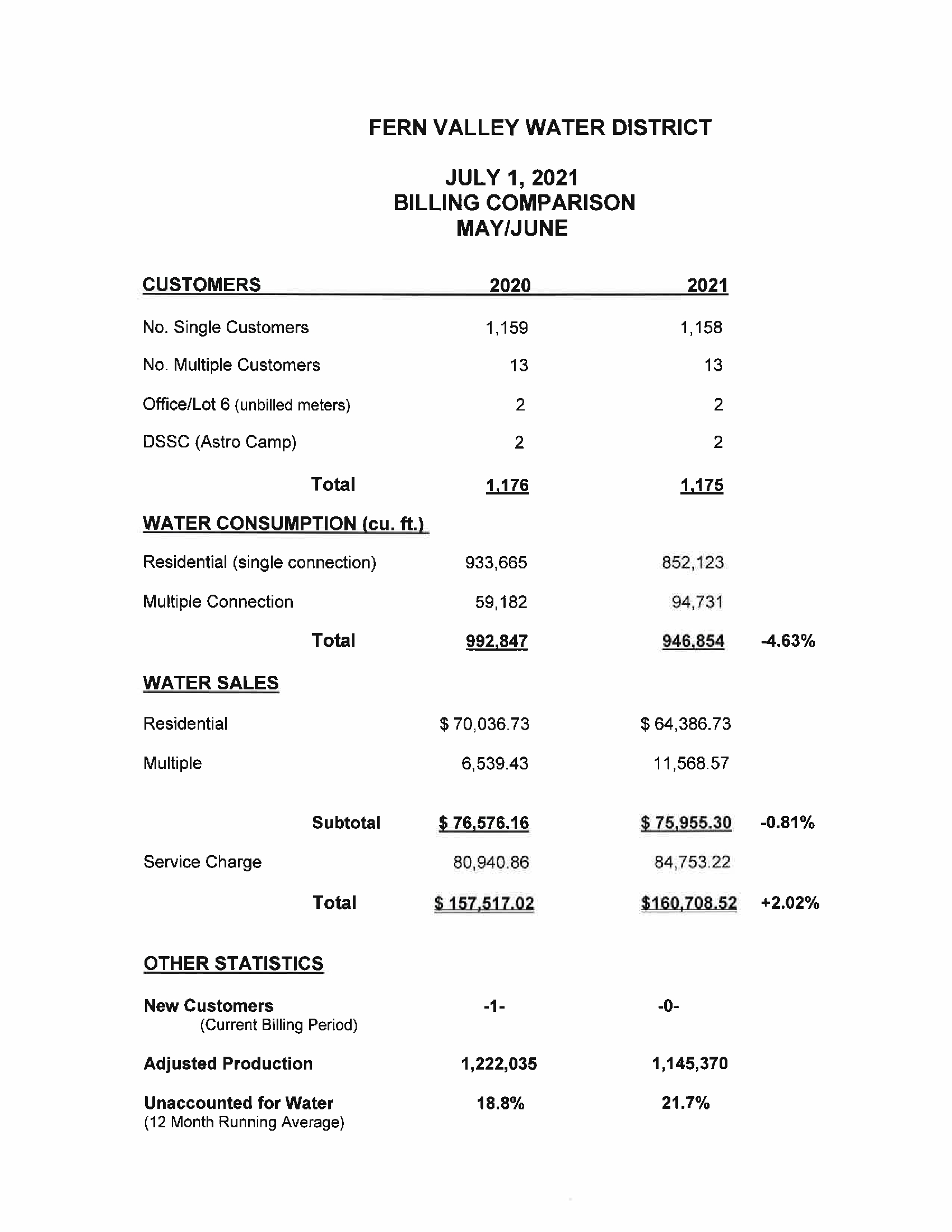
Schnetzer was struck by the difference between the 2020 and 2021 multiple user accounts comparison due to the closures as a result of COVID-19. General Manager Victor Jimenez said water loss was 17.3%.
General manager’s report
Jimenez wrote in his report, “Current demand is averaging approximately 107 gallons per minute. Total Organic Carbon [TOC] readings remain at acceptable levels allowing use of Tahquitz Creek, which is averaging approximately 29 gallons per minute.
“Treated water storage is at 3.5 MG, 81.6% of maximum capacity (4.29 MG) and raw water storage is at 2.28 MG, 97% of maximum capacity (2.34 MG). Production has increased by approximately 1% from the same month last year.”
Staff repaired a detected leak.
Gates resignation
No firm answer has been received by the district from the county Registrar of Voters office on how to proceed with the upcoming election and the resignation of Gates. The district spoke with its legal counsel, who said he doesn’t see a problem with an appointment to fill the seat and that the district may have to go through an appointment twice — one now and another again in December at the end of Gates’ term.
Directors’ comments
Bonneau inquired about installing solar. Jimenez submitted data to one of the companies that responded to his request. He sent the requested bills but has not heard back on what else is needed from the district. Jimenez will search for other competitive companies if another company is needed.
Jimenez told the board that if he sees a drop in well level, he will discuss moving to stage 3 water conservation with the board.
Hydrants
The district has identified another 40 fire hydrants that can be upgraded and about 41 more that would require a pipeline replacement in order to be upgraded.
The 5-year plan will tackle 10 hydrants per year instead of all 40 at one time like the last/current hydrant replacement project. The district has 212 hydrants and has five more to do in the initial batch of 45 the district is replacing. Jimenez said field staff are able to do a hydrant replacement a day and can do two to three a week now, so the hydrant replacement will not take as long as it did in the beginning. Hydrant replacement can only occur in the summer months. The cost for 39 hydrants was about $200,000 in materials to complete in-house. Total cost per hydrant is about $5,000.
The next meeting is scheduled for Aug. 20.