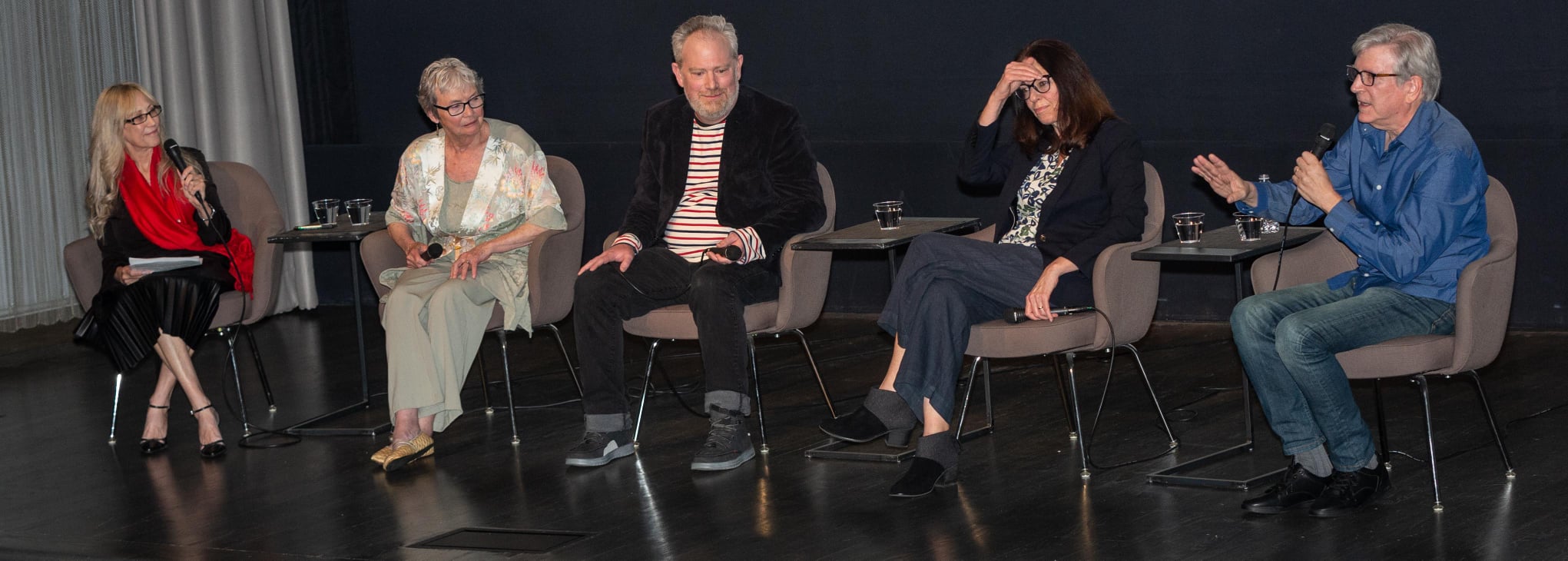
“Fiddler’s Journey to the Big Screen,” a new documentary about the making of the musical “Fiddler on the Roof,” will be screened at the Rustic Theater at 3 p.m. Saturday, June 18. An informal Q and A session with Fiddler cast member and longtime Idyllwilder Michèle Marsh, who played the middle of Tevye’s three marriageable daughters, Hodel.
PHOTO BY PETER SZABADI
The Los Angeles Times called the film “… as wonderous, buoyant and heartwarming as the film it celebrates …” and “… a much deserved love letter to the long and socially conscious career of [director] Toronto-born Jewison …”
Last year marked the 50th anniversary of the film, which was nominated for eight Oscars and won three, and shows up on any short list of great film adaptations of Broadway musicals. The documentary includes interviews old and new with participants including Director Norman Jewison, conductor and arranger John Williams, Topol (Tevye), his three daughters (Rosalind Harris, Marsh and Neva Small) and lyricist Sheldon Harnick. Jeff Goldblum narrates the film.
Director Daniel Raim’s previous documentaries have focused on behind-the-scenes artists who helped make great films look the way they did: “The Man on Lincoln’s Nose” treated Alfred Hitchcocks’s production designer Robert Boyle, and “Harold and Lillian: A Hollywood Love Story” follows the careers of storyboard artist Harold Michelson (remember that shot from “The Graduate” of Dustin Hoffman framed by Anne Bancroft’s crooked leg?) and researcher Lilian Michelson. Lillian, incidentally, was responsible for the research into Eastern European shtetl life that made the village of Anatevka in “Fiddler On The Roof” such a believable world. Both these other films are also “deep dives” into film art and the human stories behind it.
The Crier spoke with Marsh about how she came to be cast as Hodel, and the upcoming event.
TC: “You have done other Q and A sessions after screenings of the film?”
MM: “Only one, the opening in Los Angeles’ the other two [director Raim and producer Berman] did the opening in New York.”
TC: “The opening at the Museum or Tolerance?”
MM: “It was very nice — the theater seats like 300 — there was a full house, very responsive audience. With the things happening in the Ukraine now, and Fiddler treating intolerance, they thought it very relevant. In the trailer they included the clip where Norman said he didn’t want it to be a film just for Jewish people, but for everybody; he wanted everyone to relate. When he was asked, ‘What would you say if we asked you to direct,’ he said, ‘What would you say if I told you I’m a goy?’”
TC: “Jewison likes that story, being used to people assuming he is Jewish because of his name.”
Indeed, Fiddler stands out for its universality. It is three coming-of-age stories, and in each one the viewer identifies with both father and daughter, understanding both the “immovable object” of Tevye’s traditions and the “irresistible force” of the daughters seeking their own destinies. And with history casting long shadows, we all recognize that our own lives are as unlikely and precarious as, well, as a fiddler on the roof.
Marsh related for our readers the story of how she came to her part in Fiddler: “For me, when I was cast I thought, ‘I’m not Jewish.’ I thought Norman was going to regret casting me. I got all these books and began doing research on Judaism and Jewish mysticism and the faith. When we were in London after we had recorded the musical numbers and rehearsed the dance numbers, Norman had Paul Michael Glaser [Perchik, Hodels’ love] and myself to fit us with brown contact lenses because we had blue eyes. We were supposed to wear them during the two weeks before shooting so we could adapt. When we showed up Michael had gotten used to wearing them, but all that Norman got from me was squinting, because I couldn’t get used to wearing them. Then he discovered that Rosalind Harris, who played my older sister Tzeitel, and who is Jewish, had blue eyes, and the exact same shade as me, and also the man who played Lazar Wolf, the butcher, he also had blue eyes, and he’s very Jewish. So I got to keep my own eyes.
“I don’t think I realized how lucky I was to be cast in this; it was such a fluke, getting it. I was out of college, I met a young man, Joel, and we moved into an apartment together. We were hired by the American Conservatory theater in San Francisco. The managing director hired us and put us on a journeyman’s contract, that was like $85 a week, ‘Whoo hoo!’ Then the artistic director Bill Ball came back from a ‘cure’ in Spain and said, ‘We have to let them go, we can’t have all these young actors making $85 a week.’ Thank goodness I had moved in with my boyfriend, otherwise I would been jobless and homeless. “Then my boyfriend, who was kept on [at ACT] because he was also a stage manager, heard that ‘Oh! Calcutta!,’ which was still running on Broadway — sketches about sex, had nudity, (this was after ‘Hair’) — needed understudies. I thought, ‘As long as I’m an understudy, hopefully I will never have to go onstage, I could never explain that to my parents.’ Like a month later the producers called me and said they want to open it in LA, ‘Can you come down and open it?’ I said, ‘No way!’
“[At this time] Joel the boyfriend said, ‘The next step is marriage and I’m not ready for it,’ and broke up with me. [Then the people doing ‘Oh! Calcutta!’] called and said, ‘We just fired a girl in the LA cast and we’re opening in two days, can you please come down and open the show?’ I couldn’t wait to get out of SF. Joel arranged for me to live with his Aunt Sandy in Beverly Hills, married to a television producer, and he drove me down.”
About her run with “Oh! Calcutta!,” Marsh recalled that “at one point we were all arrested for indecent exposure, we were all fingerprinted and ‘mugged.’” Then Joel’s Aunt Sally heard that they were casting “Fiddler On The Roof.” “She called the production company, Samuel Goldwyn Studios, and said, ‘I have an actress here. Can she come in and audition for Jewison?’ They said, ‘Send in a résumé and a picture.’ She said to me, ‘No, you take it in person.’ That was in the old days when there wasn’t all this security; you could walk right on to the lot. I met his secretary and she asked, ‘Can you sing?’ I nodded yes. ‘Can you dance?’ I nodded yes. Then she said, ‘Norman has already auditioned here and in New York and London, he’s in Israel now …’
“About a week later I got a call from the casting director. I went in and read for him. He said, ‘Great, have these two scenes and these two songs memorized for tomorrow at 2 o’clock.’ So I knew the play because I had done the play in high school. It was called “Tevye and His Daughters” before it was a musical. I went and bought the LPs and listened to them over and over again. And so the next day I showed up at 2 and read. Who was at the piano to accompany me was John Williams. I read, Norman gave me adjustments, I used his suggestions, his direction. I sang, he gave me some adjustments, I worked with that, they said, ‘Thank you.’ He also asked me, ‘What are you doing now?’ I said, ‘I’m in ‘Oh! Calcutta!’ and I hate it!’ He looked at me and leaned back and said, ‘I was there on opening night.’ He knew the producer Hillard Elkins. I thought, ‘I’m screwed.’
“A week later they called me for a screen test. I had three screen tests … If Joel hadn’t broken up with me, I would never have the taken the job, never have left San Francisco. By the end, Joel came back down and ultimately, we got married. He was with me in Yugoslavia; they gave him a small part in the movie. I thought it was a tragedy that he was breaking up with me; it turned out to be the big turning point in my life. It remains one of the most important things in my life, a true gift that is still giving.”
About the Saturday “hometown” screening, Marsh said, “It is very exciting my friends want to come see it. The only thing that’s disappointing is that [director] Daniel and [producer] Sasha won’t be here. They were looking forward to coming up here and spending the weekend. He just got a new job, a documentary in Japan, and with travel preparation, and concerns about COVID … he was questioning me about our recent trip to Italy, tests before flights … I would love as many people to come as possible; I would love for everybody to come. It’s at 3 … The Q and A is informal, I’ll be casual.”
Berman sent her regrets, but added, “Michèle is the star attraction!”