
The prospect for the reopening of the Lowman Hall performance space to the expecting public was quite favorable this past Sunday, with mild enough temperatures and despite brisk winds and partial cloudiness. Inside, the stage itself resembled an operating theater, with a scrupulously clean setting, with only chairs and microphones interrupting a whitened, bare and illuminated circle. Nevertheless, the anticipation in the atmosphere was salutatory enough, with many of the attendees unmasked and at the ready, to welcome once again David Pelham and the “Art of the Guitar” series to the Idyllwild Arts campus.
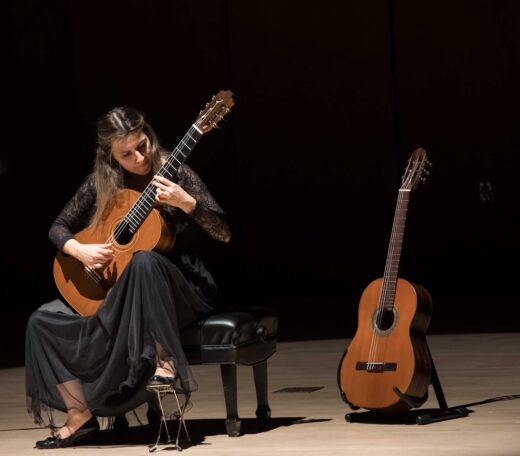
PHOTO BY PETER SZABADI
After a short introduction by Pelham, the long anticipated return began by welcoming the Mexican guitarist Alberto Daniel Quintanilla with a varied program of well-chosen works, beginning with John Dowland’s “Lacrimae Pavan” in an appropriately somber mood, which served as a display of the artist’s talent as well as the hall’s acoustic capabilities. Both qualities also were observed in the following piece, Mauro Giuliani’s “Rossiniana #1”; fulfilling the task of presenting the craft of virtuosity as well as the fitting of operatic excerpts together.
Further artistic deftness followed in the two movements of Cuban composer Leo Brouwer’s “Sonata I,” with the “Sarabanda de Scriabin” paying tribute to the mystical aspects of the Russian composer, and the “Toccata de Pasquini” emphasizing the coloristic contrasts of the entire fretboard.
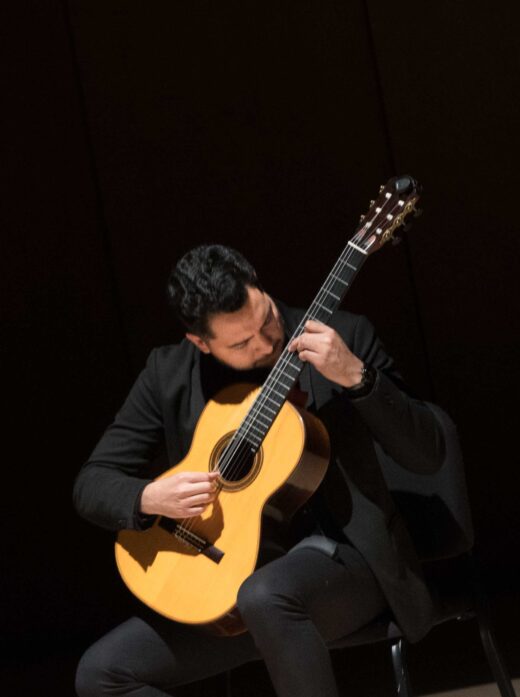
PHOTO BY PETER SZABADI
The two concluding offerings by Señor Quintanilla were designed to put the listener at ease with guitar sonics; in a tribute to his teacher, Rodrigo Nefthali’s composition “Del otro lado del puente” (“From the Other Side of the Bridge”) sent a message of calm in the midst of U.S. and Mexican border relations, and Luiz Bonfa’s “Passeio no Rio” (“Walking Through Rio”) provided happy relief in the composer’s most popular, jazz-influenced vein.
The second part of the performance, featuring Turkish guitarist Aysegül Koca, began with a virtuoso display quite unparalleled in any location (and certainly in Idyllwild). Playing a specially tuned instrument, Ms. Koca assayed the Italian composer Carlo Domeniconi’s tribute to his travels in Turkey titled “Koyunbaba,” which fused the countryside’s Oriental modes with a Western sensitivity, and provided the audience with an exhibition of appropriate displays of Arabic oud (or more accurately, Turkish baglama) technique; this listener could discern quarter-tone effects with relative ease.
There followed a meditative piece by 19th century composer Giulio Regondi titled “Reverie” (on regularly-tuned guitar), which gave forth a similar calmness to the overall setting after the initial display; the piece’s general effect (including the tremoli sections) was of tender care, which Ms. Koca’s playing demonstrated in abundance.
The remainder of her program (as was the case with the first part) was a convenient blend of classical and popular sonics; Astor Piazzolla’s two vignettes of Buenos Aires in winter and spring (“Invierno Porteno”/“Primavera Portena”) gave out distinct and implicative inferences into the Argentine city’s lifestyles; the former indicating the dour mood of mid-August and the latter replete with modified tango rhythms.
The Spanish side of the guitar also was evidenced in her rendition of Joaquin Turina’s “Sevillana,” and following that, a short encore piece based on an Azerbaijani folk melody also was appreciated. Then, with both players centrally located, the audience gave out the well-deserved approbations; and (to continue the surgical metaphoric conceit) the operation was a success, and “The Art of the Guitar” series survives.