Plastic bags. Love ‘em, hate ‘em, need ‘em, environmental threat, so what? They are ubiquitous. In our pantries, in our trash, on the roads, waterways and especially at the transfer station.
So what, they’re recyclable. Or are they?
The number of plastics generated has increased nearly six times since 1980 and more than 40% in the past 20 years. In 1980, less than 1% was recycled. By 2018, nearly 9% of plastics were recycled. The preponderance still goes to landfills.
In early November 2022, California Attorney General Rob Bonta challenged the bags’ manufacturers. He “demanded” that manufacturers substantiate their claims that the bags are recyclable.
In his press release, Bonta said, “The six manufacturers provide a large portion of the bags used by California grocery retailers and have certified that these bags meet recyclability requirements as required by state law [Senate Bill] 270. However, despite the manufacturers’ claims and widespread consumer belief in recycling, plastic bags do not, in fact, appear to generally be recyclable, let alone ‘recyclable in the state,’ as required for such bags sold in California.”
He gave them — Novolex, Revolution, Inteplast, Advance Polybag, Metro Polybag and Papier-Mettler — a Nov. 16 deadline to provide the data to prove their bags can be recycled in California. As of the end of 2022, Bonta’s staff would not comment on the status of the investigation or if all the companies responded.
Single-use, non-recyclable plastic bags have been banned in California since 2016, when SB 270 went into effect statewide as part of an effort to curb growing plastic pollution. The law allows paper or reusable plastic bags, with the stipulation that reusable plastic bags be able to withstand at least 125 uses and be recyclable in the state.
As of now, makers of the bags get to self-certify to the state that their bags can be recycled. But Bonta said that requires a comprehensive system to collect, process and sell the used bags, none of which exist. Putting the bags in most curbside recycling bins interferes with recycling other products by clogging equipment and increasing the risk of worker injury, he said.
On Facebook, Bonta announced, “Plastic bag manufacturers must back up their claims or face enforcement action.”
“Most Californians are under the impression that plastic bags are recyclable,” said Bonta. “It’s a logical conclusion: California has banned single-use plastics, and we see the ‘chasing arrows’ symbol or 100% recyclable printed on most every bag we get from the grocery store. But astonishingly, there’s a good chance that most, if not all, of these bags are not actually recyclable in California.”
A November 2022 article on Route Fifty (www.route-fifty.com/management/2022/11/plastics-industry-says-its-bags-are-recyclable-californias-attorney-general-wants-proof/379492/ a Government Executive publication), stated that “California residents can’t recycle plastic bags through their curbside recycling programs, as virtually none of the state’s material recovery facilities will accept them. Companies have argued around this by adding ‘store drop-off’ to their recycling labels, with the idea that consumers could gather their plastic bags and drop them off at a Walmart or some other participating retailer. In theory, the bags would then be picked up and reprocessed at a more specialized facility.
“What little plastic may be collected through these programs is unlikely to be turned into new plastic products. Recycled plastics tend not to be price-competitive with virgin plastics, and plastic bags in particular must usually be ‘downcycled’ into lower quality material like drainage pipes.”
Riverside County’s Waste Management Department’s website has information on plastics at www.rcwaste.org/Waste-Guide/Plastic.
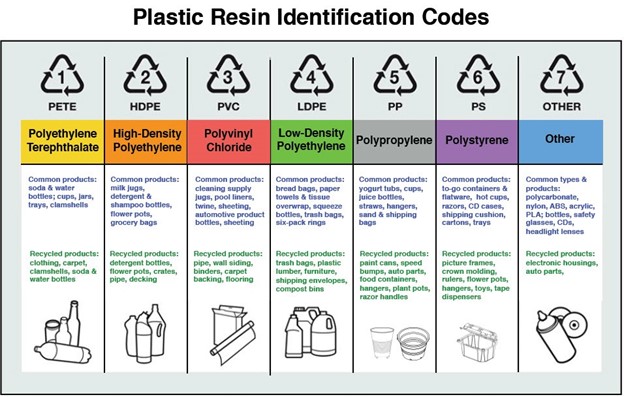
“Recyclable plastics are identified by a plastic resin number surrounded by chasing arrows usually molded into the container and are commonly found on the bottom or side of plastic containers. Resin numbers are used to identify the type of plastic and the molding process. Most plastic containers found in a home pantry are recyclable and have plastic resin codes. Plastics without resin identification numbers are not recyclable and should be disposed of with solid waste. When shopping for products in plastic containers, take into consideration if the plastic is recyclable (look for the plastic resin number) or reusable for another need, before purchasing. However, not every solid waste hauler can recycle the same types of plastics, it depends on where the materials are taken for sorting. Always check with your hauler to see what they accept in the recycling bins.”
Earth 911 (earth911.com/) did not list any plastic bag recyclers near the Hill’s ZIP code 92549. The response was, “Wow, no listings? Sorry about that!”