
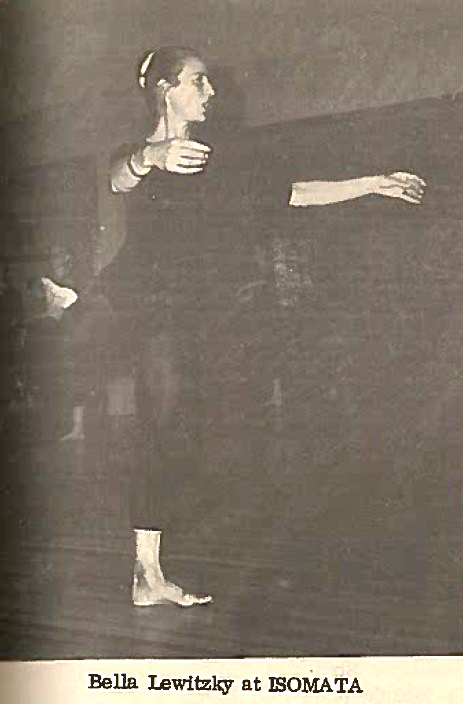
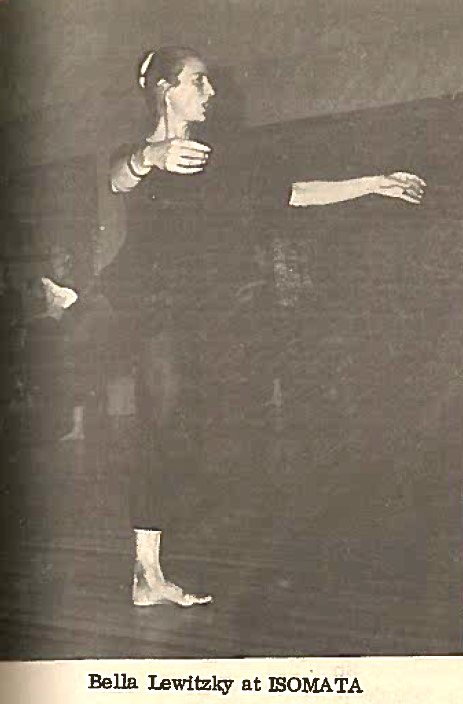
A new film biography of dancer and choreographer Bella Lewitzky, “Bella,” will be included in this year’s Idyllwild International Festival of Cinema (IIFC) scheduled to be screened at 6 p.m. Friday, March 10, in Town Hall. Lewitzky was a giant of modern dance, founding dance programs at both ISOMATA (now Idyllwild Arts Academy [IAA]) and CalArts. The film has another connection to Idyllwild, in that two Idyllwilders who worked with Lewitzky appear in it. Dancer Iris Pell was a member of Lewitzky’s company, and her husband, Peter Davison, was an accompanist for them and provided the soundtrack for the film. Pell’s performance of a set of floor exercises Lewitzky composed is one of the film’s high points.
Producer/Director Bridget Murname completed a master’s degree in dance before a master’s degree in fine arts in television and film production (both at UCLA) and this hints at the sympathy and understanding she brings to the subject. The film has already garnered awards; Best Feature Documentary at the Worldwide Women’s Film Festival in Scottsdale, Arizona, and Best Feature Documentary at Dance Camera West’s 2023 festival.
The late Lewitzky also was an activist who risked her own career rather than compromise her ideals. Her first public battle was against Sen. Joseph McCarthy’s House Un-American Activities Committee. Summoned to provide names of socialists in the arts, she memorably told the committee, “I am not a singer, I am a dancer.” Her refusal to name names led to being blacklisted. When she did receive work, it was uncredited to avoid scrutiny from “the authorities.” In 1990, she refused to sign an “anti-pornography” clause in a National Endowment for the Arts (NEA) grant, cutting off her company’s funding. She sued the NEA and won, but not before she had lost half her dancers.
PHOTO COURTESY OF THE PALM SPRINGS FILM FESTIVAL
The film is intensely beautiful and moving. It makes the viewer want to dance. Lewitzky is fascinating as a dancer, choreographer and human being, a leader and teacher interested in humanity above all. Archival footage takes us from her early performances with East Coast choreographer Lester Horton to her own journey to go beyond that iconoclast to a greater freedom and truth. Extensive interviews with Lewitzky and her dancers give a rich portrait of a deep thinker. In her own words, “Dance has the human body as its sole instrument. The artist and the art are one. Therefore, it celebrates the human being as no other art form can. Self-identity is natural and unavoidable.” Lewitzky emerges as a philosopher of dance; for her, dancing is a way of living and of investigating what life is — the facts like gravity and surface, the possibilities of the body, the joy of movement.
Then there is the question of narrative; those early commercial films of Horton’s work are big production pieces, tropes on familiar, now dated and often “exotic” themes. On her own Lewitzky sought dance as a thing that doesn’t need a reference outside itself, and then finds a synthesis. Dance doesn’t need to be narrative to be tragic or triumphant. Ideas of freedom and constraint, love and alienation are expressed in a language that owes nothing to speech. All these ideas are made clear with the deft interpolation of interviews, rehearsal footage and performances.
Pell and Davison sat down for an interview with the Crier this week. We discussed their parts in the story, and Idyllwild’s.
TC: Can you tell us how you first came to Idyllwild?
IP: I came to Idyllwild with Bella’s company in the early ’70s. Idyllwild Arts was called ISOMATA then. She would come in the summer for two or three weeks at a time. She was the head of the dance program for ISOMATA. We would teach workshops and people would come from all over. I think it started from elementary school up through adult. We had the outdoor areas; it was beautiful in the summertime. You could dance outside and we had live accompaniment. That’s where Peter comes in, in around ’78. Before that Bella would sometimes finish her dances up here and premier them in the older theater at IAA. We would work all day long. We’d start in the morning teaching technique classes, afternoon she’d have improvisation and dance design classes. The company always taught and she taught, and when I first came to the company she was still performing so she was a complete inspiration to me.
FILE PHOTO
I met her when she was 56 and I was in my senior year of high school. Then I came to California to go to CalArts. She was the dean of the dance department there. Idyllwild was a really important place to Bella. She loved it. She was invigorated every time she came up … We would teach all day and then after dinner we would rehearse, and she would work on her dances, or we would prepare for the concert that was coming up. Sometimes we’d start around 6 p.m. and go until 10 or 10:30. Everyone loved [Idyllwild]. It was so different from Los Angeles. I just couldn’t believe it. Then in ’78 Peter comes in, why don’t you take over?
PD: It was the summer of ’78 and a friend of mine said “Hey they’re having these Bella Lewitzky classes up in Idyllwild and they are looking for accompanists. I had no idea. I knew the name Bella Lewitzky. I’d never heard of Idyllwild.
TC: Where were you living then?
PD: Santa Monica. I lived in the same house in Santa Monica for 34 years and then I moved up here. I’m the type of person who likes to live in one house, not have to move.
TC: A homebody?
PD: Yeah. So, I was a full-time TV and film composer at the time and I realized that I had a hiatus … In ’77, I received a California Arts Council grant, a commission of eight pieces for 14 instruments for performance at the Morgan Theater in Santa Monica. I worked really hard on that, and I was done with it so I didn’t really have anything to do, so I thought, “Let’s see where Idyllwild is.” I had been an accompanist for dance classes on the flute; I probably started in ’74. I taught at various dance studios. It paid well and I was going to college.
TC: Dance is a nice opportunity for a composer, a lot of freedom?
PD: You watch beautiful [mainly] women dance and you interpret their movement. I had to audition for the Lewitzky company at their studio at, was it Studio City?
IP: It was in the Hollywood Hills.
PD: Immediately south of Studio City.
TC: Was that their home and studio?
IP: That was Bella’s house that had a studio attached.
PD: Near the Cahuenga underpass of the Hollywood Freeway.
IP: It was way up on the hill so you could see all below. And her husband Newell [Taylor Reynolds] designed it and built it.
PD: I got there and I was a little nervous. This was a professional dance company, a whole different thing. I got there and figured out where the studio was, and it was completely open and nobody was there.
IP: It must have been on our lunch break.
PD: I found a chair in the studio and got set up to accompany, and then all of a sudden, like a curtain went up …
IP: There wasn’t a curtain. There was a door that opened up from in the house.
PD: Well, it seemed to me like … in some magical way the entire Lewitzky company came through a normal size door all at once.
IP: This is part imagination.
TC: It seemed to you as if a curtain had opened and the goddess of dance had materialized with all her acolytes?
PD: I think that’s what it was. That’s how I remember it. At the end of the line, I saw this, like unbelievably beautiful lady who, it turned, out was Iris. I had been watching dance students, college dance students, high school dance students, some of the classes I did over a period of three years, so I saw dancers improve, and I had.a pretty good eye for what it’s supposed to look like … every person in that company was there, at that certain level … I must have accompanied well because I got the gig.
I got these instructions on how to get to Idyllwild. I got off at the 8th Street offramp … started going up into the mountains. I was amazed, I just had no idea, it kept going up and up, I think I’m heading to Switzerland or something. I got higher up into Idyllwild and I remember being really impressed when I got to the stop sign on the edge of town and slowly drove in. The Fort wasn’t there yet. I thought “God, I wonder if I could live here?”
TC: Where did you stay?
PD: You know where 243 curves around and you can turn left and go up South Circle Drive? Right there …
IP: Kind of a bed-and-breakfast now (Strawberry Creek Inn.)
PD: A two-story house and a bit of Strawberry Creek in the backyard. It was a private home then.
IP: The company would rent houses for all of us to stay in.
PD: As I remember, I got paid plus it included housing. I had to accompany between 9 [a.m.] and 1 [p.m.]. I started playing at these beautiful outdoor dance floors. I played the flute and I could play as loud as I wanted; it just echoed through the trees. Amazing. I kept getting assigned to the class of the lady that I saw the very first day; it turned out to be Iris. She was just such a good teacher. She had this energy of creativity and being in the moment and doing your best … I got into the habit of just walking around the outdoor dance stage while playing.
IP: I was impressed with him, that he didn’t stay in one spot.
TC: He added an element of inhabiting the space?
IP: Yes.
PD: Then Iris and I started talking; of course, after the class.
IP: We went to a dinner and sat next to each other and had a conversation. There were all kinds of people up here in the summer, like Jonas Salk [virologist and medical researcher who developed the polio vaccine], amazing people teaching art, writing, everything. It was an outdoor buffet; we sat together. We immediately had good rapport with each other.
PD: And it turned out we lived a mile or less apart in Santa Monica.
IP: I was teaching a workshop and needed an accompanist and so I asked Peter if he would be interested in accompanying my class and so we exchanged phone numbers. I called him up to arrange that and he invited me over to his house to listen to the music he was working on for this concert that was coming up. And we just became friends right away.
Pell and Davison began to protest that the film is about Bella Lewitzky, not them. But Lewitzky’s story is a large one, and they help connect it to Idyllwild and the readers. Pell described how much Lewitzky meant to those who knew her. who she came in contact with. She’s very vivid in all these people’s memories — who knew her or studied with her or listened to her speak, and how the film brings her voice back and you can really hear who she is and it’s just wonderful because when she spoke she got to the core of things, she was so articulate and in her speaking, in her dancing and in her choreography, in her life she just knew how to go really deep and to show what was really real and what was true and honest. She brought that out of people.
TC: The audience feels that; she’s a great teacher and a great communicator.
IP: In every class that she taught, and I was in her company for 12 years, there was not a moment that she wasn’t completely there physically, mentally. Her energy was so amazing. When she walked into the studio you just felt it. She made you want to be the best you could be, because she always worked to be the best. Creating art that really shows what humanity was all about … You could see it in her movement, it was not just surface it was deep from within. Even when she taught, in the film you can see her go up to a student and take the body and mold where it needs to be and then you could feel that in your body, “Hey now, that is deep motion.”
TC: Something different from what you were doing and you understand why it’s different.
IP: It was total, from yourself, it wasn’t halfway there.
TC: It wasn’t imitating something, it was being something.
IP: That was the other thing. She didn’t want you to be her, she wanted you to be you and she wanted you to express you from yourself.
Peter discussed his part in providing music for the film.
PD: There are three kinds of music in the film: There’s original music, like for the Lester Horton (pieces), there is archival film, some of them have a soundtrack. The second kind is the dance classes or the performances of the Bella Lewitzky dance company, the music is by Larry Attaway. He was the music director for the company. Then there were lots of empty places …
TC: Underscoring?
PD: Yes, also some of the music in the [original] films didn’t quite work for the film. I’d say it’s about one-third music from the original dances prior to Larry Attaway, one-third by Larry Attaway and one-third Peter Davison. I said to Brigette, “Maybe it should say, ‘Music by Larry Attaway, additional music by Peter Davison,’ and she inverts it, the credits say, “Music by Peter Davison, additional music by Larry Attaway.”
IP: But at the end it shows all the scores that Larry did.
PD: It brought back a lot of memories. You have to watch the film over and over again, as the film gets made it changes.
IP: Peter did a portion that shows a Lester Horton rehearsal with drumbeats, and he did it as it would have been.
Pell also talked about her first meeting with Lewitzky, and the doors that opened as a result.
IP: I met her when I was 18, and she really helped me develop as a performer. I was in my senior year at North Carolina School of the Arts. It went junior high school through college, and you lived there. She came as a guest instructor. She taught our modern dance class. It only had eight people. She was so different from the New York teachers, so East Coast …
TC: Tied to ballet.
IP: Very tied to ballet … When she came, she was like sunshine and she was so nice and she actually lived in the high school dorms. I remember passing her in the hallway and she was always friendly and smiling. At the end of her time there she said, “Here are some applications if anyone is interested in going to California Institute of the Arts. It’s opening up.” It was going to be the first year [of the dance program.]. I picked one up. I don’t think anyone else did. I filled it out. I had decided I definitely didn’t want to stay there after my senior year. I was either going to go to New York or try to do something. That summer I was dancing in a dance drama theater on the coast of North Carolina. I found out, my mom called me, that I had been accepted, and not only had I been accepted, I got a full scholarship to go. I had never been to California. It was like a dream.
So, I went to CalArts the very first year. I was there for a month or two when she asked me to understudy for the company. Since she was dean I could go to school and also understudy. Every Tuesday, Thursday and Sunday she would rehearse the company. Tuesdays and Thursdays I would go to Cal Arts from like 9 to 5, and then we’d have rehearsal 7 to 10, then I’d drive back to North Hollywood where I was staying. I was getting like three technique classes a day. She totally believed in getting the body ready and training the body. Before every rehearsal we had an hour-and-a-half class, then before a concert we always had an hour and a half class. Not only that, we’d give a two hour concert and then we’d have a 10 or 15 minute warm down. She didn’t want her dancers to be injured. She would say, “They warm down horses.” I got stronger and stronger and stronger. Because I was studying her technique at CalArts and also in the company … I got my first role. Someone left the company and I got a couple more roles.
At the same time, I saw her perform. She would be sitting on her stool watching the company perform. She saw everything. You knew she could see right through you. Whenever I performed, I knew she saw it all. She would get up from her chair, because she did a solo called “On the Brink of Time” that was to Morton Subotnick’s music, and she would get up and do that, and then we’d do the next piece. “Kineasonata” had a solo in the third movement that she would do. [This solo figures in the film.] The company would watch her solos in between. “Wow,” all the time. It wasn’t like, “This is just a rehearsal.” It was always 100%, and she’d expect that from us, too.
Davison’s family had a passing connection to Lewitzky also.
PD: My father was the chief administer of a school called the People’s Educational Center. He started doing that in 1936. [It] was on Vine Street just south of the corner of Hollywood, Hollywood and Vine. All the stars went there. It was not just a center for progressive people in L.A., but also the progressive movie stars of Hollywood. One of the people that did go, I guess, was Lester Horton. He had these big dances. My father was in a dance which was at the Hollywood Bowl. His role was being a tree. He didn’t actually do any movement. He just walked on, posed and then walked off. So he knew Bella Lewitzky. She asked me about my father, that was cool.
TC: They shared an egalitarian vision and socialist ideals?
PD: Yeah, you could be a writer!