
The outlook for the 2023 summer fire season has benefited greatly from the wet and snowy winter.
None of the major fire units are currently predicting a serious and dangerous fire season for Southern California. Fire will always be a threat; but this year, particularly during spring, the likelihood of a major fire is significantly less than recent years.
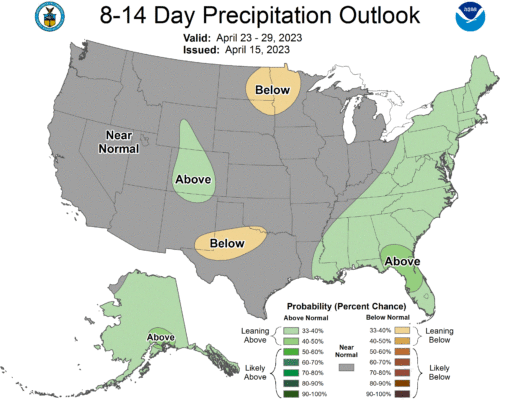
In its latest outlook, the National Interagency Fire Center (NIFC) offered this assessment: “Typically, La Niña results in a greater chance of a drier than average winter, especially in southern California. Despite this being the third consecutive winter of a La Niña, it has not been the case this year. This jet [stream] will undoubtedly weaken as winter gives way to spring, but until then, the potential for additional wetting rains may continue for a few more weeks. Rainfall should begin to wane by the middle or latter half of April, which is several weeks later than usual.”
Closer to the Hill, the Southern California Geographic Coordination Center said, “Large fire potential will be below normal in the upper regions of the mountains. Very low potential above 8,000 [feet] this spring/summer.”
National and state fire predictive services agree that the hydrological conditions in California have markedly improved in the past three months. Since January, when none of the state was free of any drought conditions, slightly more than 65% is free of drought as of April 11. About a quarter of the state is classified as abnormally dry and less than 9% is in a moderate drought condition. The three worst drought conditions (severe, extreme or exceptional) are no longer present anywhere in California.
Alex Tardy, meteorologist for the National Weather Service’s San Diego Office, reported that Idyllwild received 40.28 inches of rain since October. The average annual rainfall is 24.45 inches. This year is the seventh greatest volume of rain. The all-time high was the winter of 1982-83, when 54.07 inches fell.
While Palm Springs received an inch less than its average, even Anza-Borrego’s rainfall exceeded its average.
“March alone was a huge impact; most areas had about two times the normal March rain,” Tardy said. A shift in the jet stream caused the weather change. Thirteen atmospheric rivers passed over Southern California from November until the end of March, including five in March.
However, all of the moisture does present one concern to firefighter managers.
“The issue with the wet weather is that it brings up a robust grass crop which is the ultimate in fine flashy fuels builder. The grass crop is already growing rapidly with plenty of ground moisture left, and now plenty of sunlight to keep it growing,” wrote Idyllwild Fire Chief Mark LaMont. “These fine flashy fuels cover the landscape and create a continuous flashy fuel bed which can carry fire faster and further than when the landscape is without these fine fire carrying fuels. Fine fuels carry fire quickly and generally run uphill into larger fuel types making fires more difficult to contain.”
The Predictive Services Outlooks also advised about this condition; however, it was noted that “… the last 20 years have not shown a strong correlation between a wet winter (with an assumedly heavier than normal grass crop) and a busy ‘grass fire season.’”
The potential for a greater fire threat from the grass fires depends upon the winds, according to Predictive Services.
And NIFC wrote, “The seasonal grasses’ high amount of fuel moisture should preclude any risk of large fires in April. Heavier live fuels should retain enough moisture to be resistant to fire spread well into May.”
While concerned about the potential risk of dry grasses as a source of more fires, LaMont added a positive note, “A larger grass crop opens us up to a greater potential for more starts, more starts in the grass may be able to get ‘picked-up’ quickly by fast arriving suppression resources on scene.”
NIFC reinforced this opinion, “but without strong winds, such fires have an excellent chance of being picked up by local resources or within the first two burn periods.”
Once the summer dry weather occurs and snowmelt is finished, the risk of higher elevation fire will begin to approach normal. But Predictive Services also noted: “In 2011, fires tended to show much less activity above 8,500 feet which may also be the case this season.”
And NIFC’s Southern California Geographic Area Coordination Center concluded its April Outlook with this comment: “It is safe to assume the next several months will hold far less weather drama than what occurred the past 9 months.”