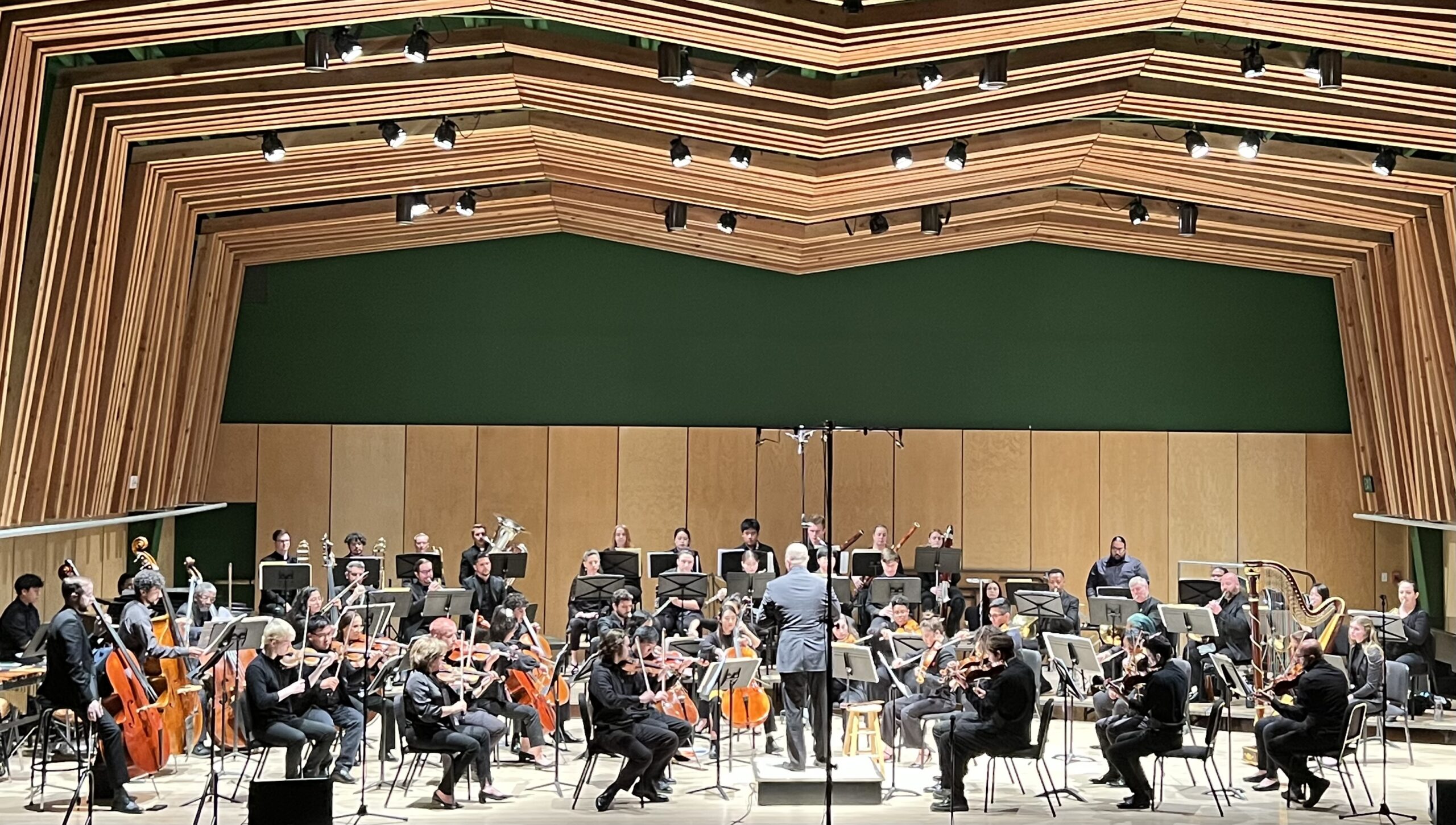
The ending of a calendar period is a somewhat somber occasion, whether it be that of a year, a month or a season; it signals a place for some type of reflection, both for the time just past and the prospects for coming events. Thus it is with the divisions of an academic year; with the disciplines well studied and tested, leading to an advancement, either graduation or another transition into the multifaceted world of nonstudent life. So with the ending of Idyllwild Arts Academy’s spring term, and the consequent final orchestral concert, Lowman Hall was filled with both kinds of anticipatory expectations from students and faculty alike.
Saturday night’s short program, focusing on the theme “Triumph of the Human Spirit,” began modestly (and somberly) enough with George Theophilus Walker’s “Lyric” for string orchestra, in the composer’s arrangement of a movement from his string quartet (originally titled “Lament”).
Admittedly somewhat programmatic, in that it reflects the Black American experience by virtue of the composer’s memory of his grandmother who was born into slavery, the work never ventured into sentiment of any kind, but sustained an understated nobility in the presentation of long melodic lines, something of an uplifting of “the human spirit” and not necessarily achieving of any “triumph.” Evenness of tonal production in a drawn-forth slow tempo was the principal effect needed, and the larger than usual string contingent, led most capably by graduating senior Concertmaster Derrick Giuntini, was more than up to the task.
With such a peaceful calm settled over the audience, one was scarcely ready for the effective presentation of a larger than usual orchestral work. The case of Dmitri Shostakovich’s “Symphony #5,” as a paradigm for individual human achievement in the face of totalitarian and bureaucratic obstacles, is well-known; the composer wrote it in response to both musical and political critical disdain. The outer movements offer the composer’s rejoinder; subtle ironies in structure and sound reveal a message of hope (again, not exactly “triumph”) in that the efforts of composition demand due respect from any authority, designated or not, and the elements of that effort should not be wasted.
The two inner movements (marked “Allegretto” and “Largo”) also present an ironic compounding, from the somewhat frivolous waltz tempo in the first instance to the slowly-rising curve of fear (or paranoia) exhibited in the latter case. The large orchestra — with a full complement of winds and brass (including five French horns), plus harp, piano, xylophone and percussion, in addition to the aforementioned string ensemble — proved well-equipped to bring forth Shostakovich’s essential message; for these players, it was indeed a triumphant realization in the last full-chordal cries of the final movement, and the audience reaction matched the resultant harmonies throughout the hall.
In short, it was a splendid conclusion to a somewhat stressful season, however still bristling with expectation for both the academy and its students.