



Two Idyllwild sisters are blazing trails artistically with the premier of their second project as Cinballera Entertainment, melding elements of cinema, ballet and opera. Tiffany, 22, and Rebekah, 19, are daughters of James and Teresa Brannan. Their new production, based on material from Tolkien’s “Lord of the Rings,” is called “Lady of the Ring,” and will take place from 7 to 8:30 p.m. Friday Sept. 22, which is also “Tolkien Day,” at Water Conservation Garden, 12122 Cuyamaca College Drive West, El Cajon. Tickets are $25. For more information, visit cinballera.org.

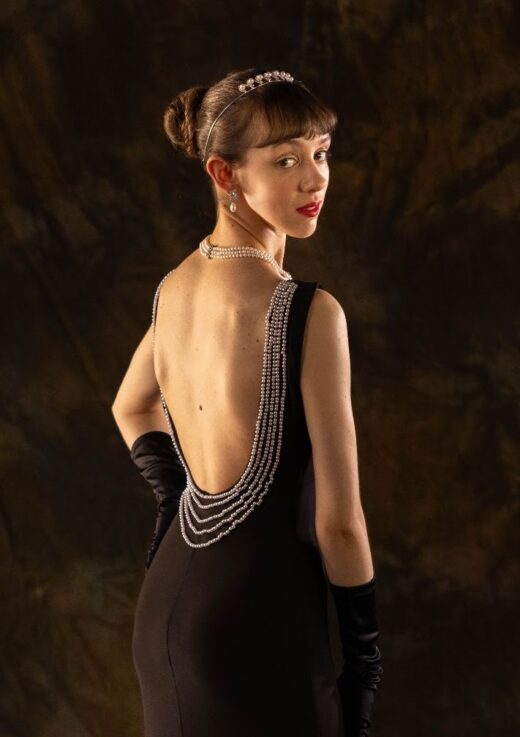
PHOTO S COURTESY OF CINBALLERA
Cinema, ballet and opera are infrastructure-intensive art forms, with costly productions and hierarchical structures where performers are “cogs in a machine,” but the Brannans have found a way to express their own visions within the traditions they love. Their first production was “Stolen Love: a Chamber Ballopera.” It combined a comic opera — Menotti’s “The Old Maid and the Thief” — with an original ballet based on that composer’s only piano concerto.
“The Lady of the Ring” tells its story twice: once through a chamber opera based on a song cycle Tolkien himself commissioned, supplemented with adaptations of art songs; and then again through an original ballet set to a Shostakovich piano concerto. The work will be realized by “a fellowship of nine performers.” The intent is to release video productions of Cinballera’s projects.
The Crier spoke by phone with Tiffany Brannan this week to find out more about the sisters and their latest project.
TC: Were you and your sister Idyllwild Arts Academy students?
TB: No. Both of us were home-schooled, and graduated at 13, but we studied privately with excellent teachers who also taught at IAA. We’ve been studying privately with college professors for singing as well as dancing since we were young. I became a professional journalist and Rebekah became a professional ballerina, and now I am a professional opera singer.
TC: Tolkien is a popular franchise.
TB: A lot of people like to do their own take on it.
TC: And this is explicitly a woman’s take?
TB: Yes. Instead of the Dark Lord, we made it a Dark Lady, and then after she is killed by Smeagol (who becomes Golem), her spirit is in the ring, and so anyone who puts it on sees her spirit, as Precious. Instead of just an evil mastermind genius she is also a femme-fatale.
TC: And femme fatales are juicy roles for an opera singer?
TB: Yes.
TC: What are some favorite femme fatales from opera?,
TB: Carmen is maybe the most famous. There is Delilah in Saint-Saëns’ “Sampson and Delilah,” there’s the Queen of the Night in Mozart’s “Magic Flute.” She was seductive but she was also very dangerous, and similar to the Dark Lady.
TC: You are premiering the work at the Water Conservation Garden? That sounds dry?
TB: Yes, the conservation garden. It is very beautiful. It has a couple of water features. Mostly it is showing how a California landscape can be laid out to minimize water usage. This garden has a wonderful amphitheater available for events, and we’re bringing our own stage.
TC: You wouldn’t want a dancer to go “en pointe” on concrete.
TB: No.
TC: And the music is a piano?
TB: Electric piano.
TC: Who is playing?
TB: Abe Fabella, a very accomplished pianist and music director for many venues. He played for our previous show and we’re using him again.
TC: So, the piece is two parts. First a concert?
TB: We put together our own opera using music by Donald Swann. He wrote the song cycle, “The Road Goes Ever On,” and Tolkien collaborated on it, in 1967.
TC: How would you describe the musical style?
TB: Very typical of English art songs from 18th century. High musical quality, but more playful than what you’d find in the movies … It gives you a kind of insight into what kind of music Tolkien thought would go with his story. We are using six out of the seven songs in the cycle, changing the words for one.
TC: You drew from sources in several languages, including Tolkien’s invented Elvish?
TB: In addition to the cycle, there are 15 art songs; we changed the lyrics to fit the story — one in German, one had Portuguese and instead we put in some Elvish text, it’s the “One Ring” song that we put in as an opening song. Besides those two, the thing is in English, so it’s very accessible.
TC: You don’t need to be a native Elvish speaker?
TB: No. One other thing that makes it easy to understand is that between songs we have Bilbo reading from his book, to tell the story the songs are portraying.
Bilbo’s “book” is the hobbit’s autobiography; during his adventure he often thinks of writing a memoir, to be titled “There and Back Again, A Hobbit’s Holiday.” The Brannans have apparently discovered his legendary “Red Book of Westmarch.”

