
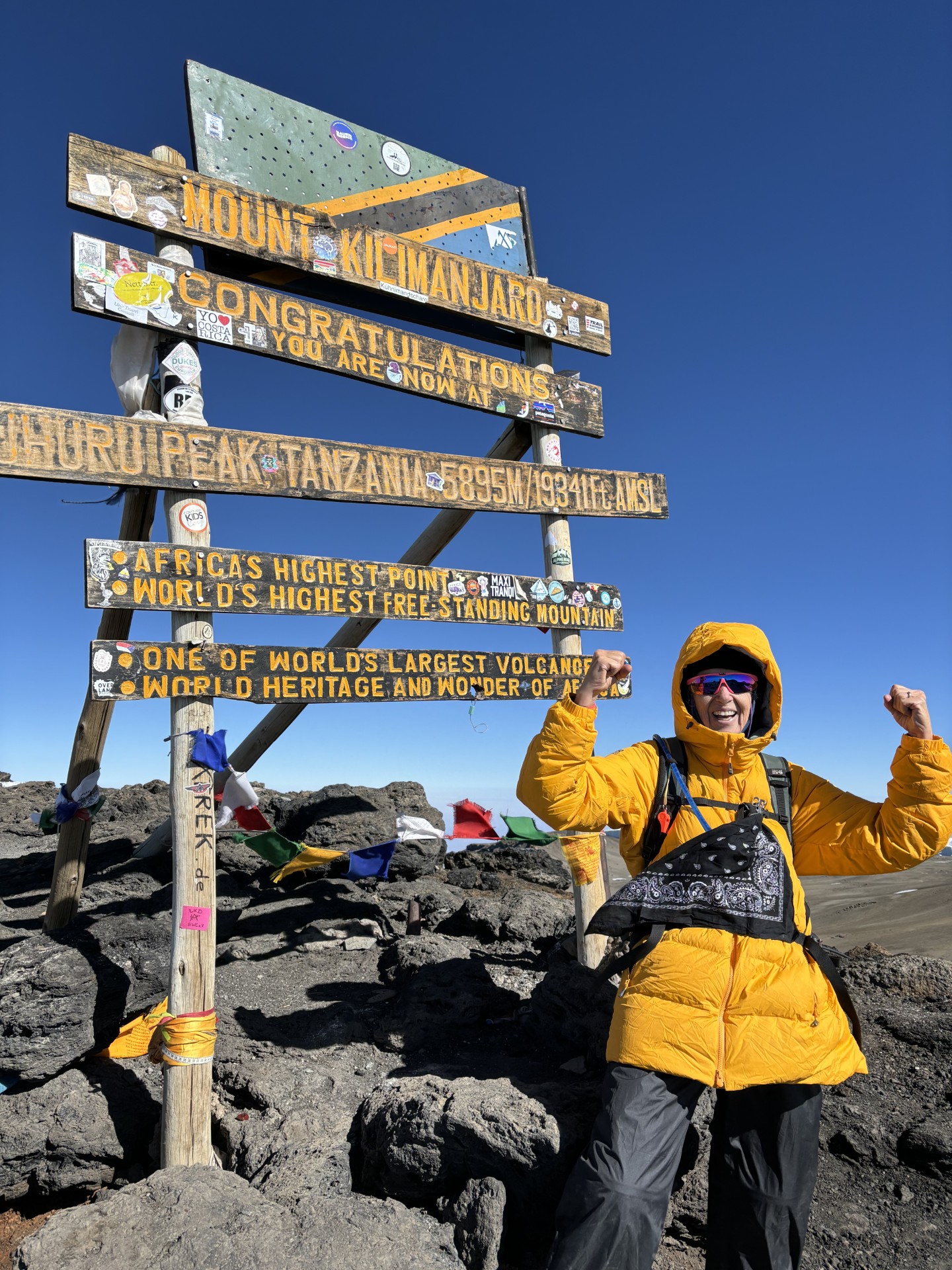
Pine Cove resident Maureen “Mo” Mullins retired last year, but has certainly not slowed down. In October she joined a group that reached the summit of Mt Kilimanjaro, the tallest mountain in Africa and the highest free-standing mountain in the world. At 71, she credits her high-altitude home, and the training she did here, for an ascent free of altitude sickness.

Mullins is an outdoorsperson of long standing. “I’ve always loved to hike. I lived down in Vista, and I used to hike in the Poway mountain area. I’m originally from northern California, I used to hike up at Stanislaus and in the northern Sierras.” She worked for many years as a Physician’s Assistant, and was a jazz vocalist in LA.
Although she has only lived here full time for five years, her connection began decades ago. “Back in the late 70s, early 80s I had a boyfriend who was a keyboard player who used to come up her and visit Lee Miracle. I used to come up with him. They were buddies and Lee lived next door to Rich Page, who was the Mister Mister guy. I always just loved this place. It took me a long time of working and getting it together to buy a place up here.”
She may be best known to locals as a musician. She is Musical Director at Queen of Angels Church, and performs with MoMoJo (with husband John Mullins, Monica Sierras and Julia Graham.) She was excited about her upcoming December 8 debut with Marshall Hawkins and his quartet at Middle Ridge Winery.

Mo with other hikers, support team, and members of Floresta
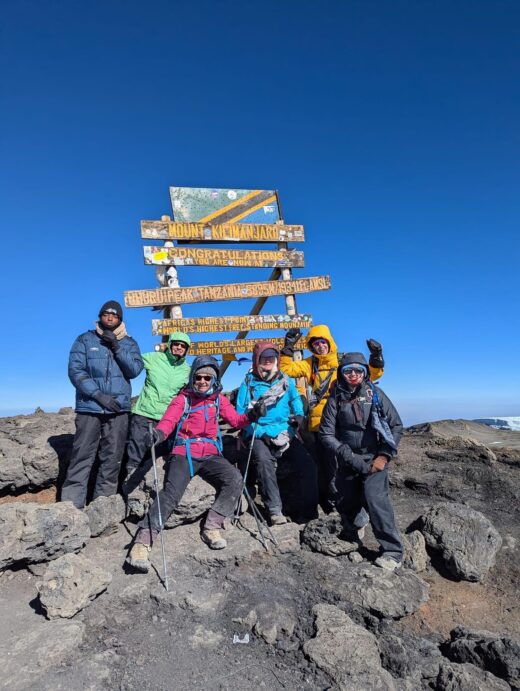
Mo, in yellow, with other hikers on the peak
The Kilimanjaro trip arose from a gift from her husband of an iFIT elliptical training machine. The machine came with a subscription that includes hikes with world-class trainers, “You basically work out with them and follow them on the trail. They usually give you a physiology lecture or something in the process. I can’t say enough about the iFIT program, I think it’s the best thing…wonderful.” The Kilimanjaro series included, in addition to the scenery of Tanzania, singing and dancing by the porters, and she was “moved to tears.” She shared her experience on Facebook and an “old hiking buddy,” Leslie Bush, saw the post and invited her to join a real expedition.
Mullins began to train. “I went to the Sierras and climbed Mount Langley in preparation, for altitude training. Langley is about 15,000 feet. I was doing a regimen where I was hiking up to San Jacinto Peak every Monday, then I was hiking to Tahquitz lookout every Friday, and every Wednesday the Webster trail, up to Thousand Trails and then back down. I had a pretty robust training program for about five months… About 35 miles a week. Because of my age, I was thinking ‘I really need to overcompensate, because I don’t want to get there and not summit.’”
The training paid off. “I tell people: I was probably ten to fifteen years older than pretty much everyone else in the group, and I was the only one that had absolutely no altitude symptoms, all the way up to 19,341 feet. The reason, I believe, is because of living up here. I live at 6,400 feet and I was really pushing the altitude in the hikes up here. I had a real advantage over everybody else. I was the first one up, and I just felt great. It was quite surprise to other people, but not to me, because I knew that I had that advantage, and access to the most amazing trails up here.
The trip took seven days, five up and two down. Hikers were supported by local guides and porters. “You carry a backpack yourself that weighs up to 20, 25 pounds. It has your extra clothes, rain gear, snacks, your water. The porters carry, your sleeping bag and other stuff on their heads. Like 50 pounds on their head, another 30 pounds on their back. These guys are amazing, and they watch you. They watched me constantly because they kept thinking that because of my age I was going to have trouble. They were always hovering, ‘are you OK?’ I was like ‘Yeah, I’m fine, you gonna eat that jerky?’”
Mullins says the trip was very well organized, “run by a gal called Cindy Outlaw.” Outlaw is on the board of the San Diego River Valley Conservancy and is planning another Kilimanjaro trip in 2025 to benefit that group. Mullins calls Outlaw “A force to be reckoned with. Right before we did Kilimanjaro they went up to Greenland, hooked themselves up to sleds and cross-country skis, and skied over the polar ice cap.”
Before the ascent of Kilimanjaro, group members spent a week working with a humanitarian organization called “Plant With Purpose,” also known as “Floresta” in Africa. “That group is teaching the Masai and the Chagga tribes agricultural methods for sustainable farming. The program includes a small tribal savings and loan type of program that people can invest in. I was amazed how it improves the lives of people. They were able to buy a goat and then a chicken… they were able to replace their mud and stick hut with cinder block. I saw firsthand some amazing improvements in these people’s lives.”
The hike itself included several distinct climactic zones. “You start off in the rain forest, real muddy, lots of rain. You get up into an alpine desert, it’s pretty open and dry, when you get up above 16,000 feet you’re in a regular alpine zone.” And yes, there are still glaciers up there. “They used to refer to ‘the snows of Kilimanjaro.’ Unfortunately, with climate change, which is a real thing, the snows are very sparse. There are glaciers left up there, but they are rapidly melting, it was heartbreaking.” The USGS says that the glaciers have been in retreat since 1880, with the thickness declining since 1960 by about a half meter per year, and the area covered decreasing from about 7.7 square miles to less than one.
Asked about future hikes, Mullins says is thinking about Patagonia and the Dolomites, in Italy. But her musical endeavors make her reluctant to leave for long. She values those relationships and the livelihoods many of her partners derive from music.