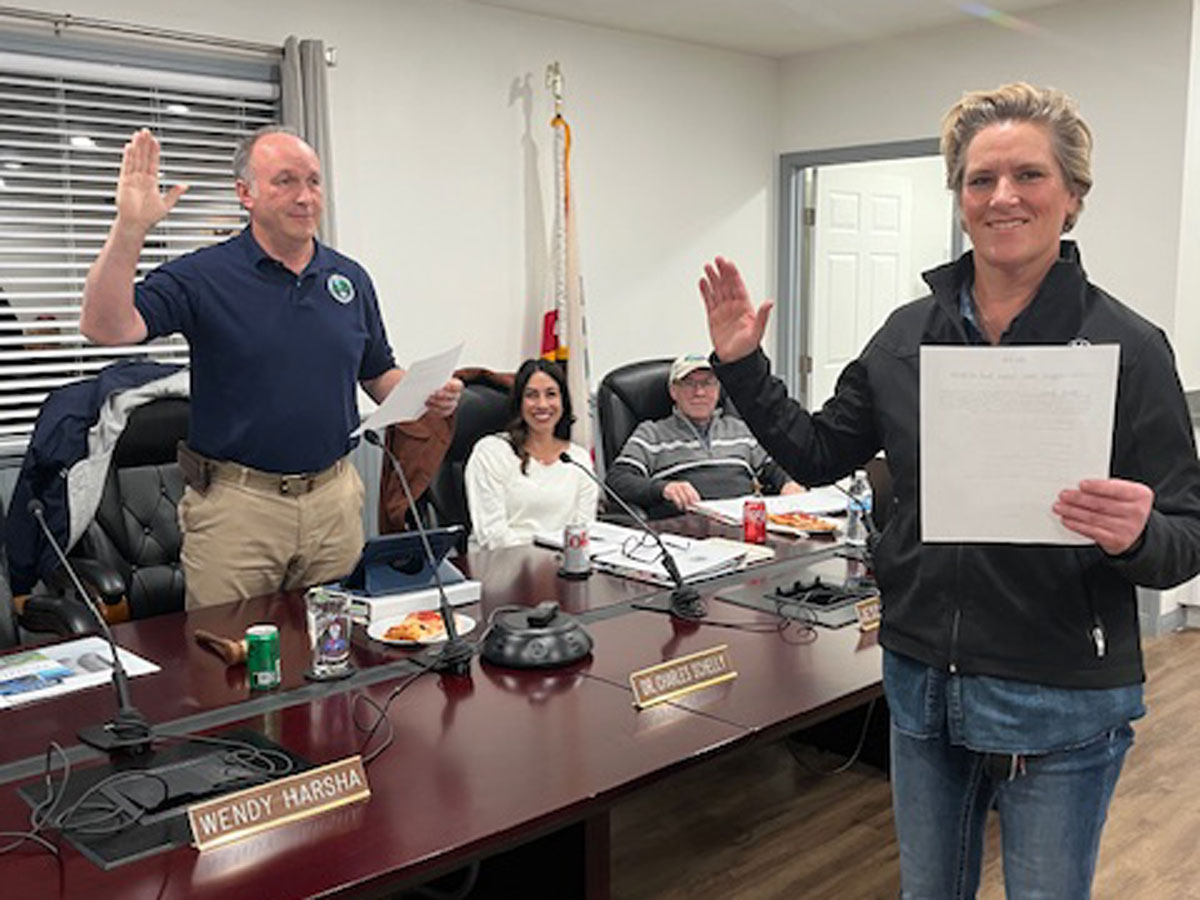
The February 19 meeting of the board of directors of Idyllwild Water District began with the swearing in of newly-appointed director Wendy Harsha. As Board President Charles Schelly pointed out, this was the first time since April 2023 that the board has had five members.
The board learned from General Manager Bill Rojas that the District has “hit a snag” in its search for grant funding for the project to replace the Wastewater Treatment Plant: Idyllwild did not qualify as an “economically disadvantaged community,” and so doesn’t “qualify for a grant principal forgiveness program at this time.” The team at Dudek, the firm working on the grant and loan application, has said that currently IWD will only qualify for a low interest loan. Rojas said that he will continue to explore the possibility of isolating the community of sewer customers and using only their data to allow the application to qualify. In most aspects of IWD’s business, water and sewer must be considered separately. Rojas said that if grants are not available even low interest loans are very expensive. Until this is resolved the WWTP project will be paused. The GM’s report continues: “Currently, Trump has put a freeze on Federal Grants for the next six months.”
Rojas said that CRWA (California Rural Water Associates) has submitted an application for $10 million grant, separate from the Dudek applications. “We’re waiting on the results,” he said. Dudek informed him that the community numbers submitted showed Idyllwild in the 83rd percentile. State water code (79505.5) defines a Disadvantaged Community as one with an annual median household income less than 80% of the statewide annual median. The application used numbers from the 2020 census, CFO Hosny Shouman said, and it may be that segregating 580 sewer customers will give different results. He added that the loan they were offered, at 1.99% interest, would cost $55 thousand per month.
Director Jessica Preifer had questions regarding the WWTP project, asking if rehabbing the existing system might be possible. Rojas answered that this was “not out of the question.” Preifer also asked if there was a projected start date for construction, and Rojas said that would have to wait for the engineering to be completed; the initial 30% of engineering was finished last year by SUSP (Specialized Utilities Services Program Engineering), a benchmark that allows loan and grant applications. SUSP is working on the complete plans incorporating feedback from IWD’s management and crew, with Dudek reviewing the work.
Priefer asked about how the census data was compiled, and whether resident participation affects the results. Stephanie Yost asked what areas were included in the community census, and Shouman said that he believed the figures were for “Idyllwild/Pine Cove,” including Fern Valley. Schelly said the next step was to “look at it more thoroughly and get it to a more accurate rendering of where the district is.”
A member of the public pointed out the importance of the sewer system to the downtown business district, and the importance of that district to areas like Mountain Center, asking about the utility of petitions and contacting elected officials. Schelly answered that the District will be reaching out to everyone with responsibility for Idyllwild, mentioning Representative Ken Calvert. He welcomed public involvement but wanted to get “a few more ducks in a row,” including the completion of the engineering, before reaching out to elected officials on behalf of the district. The questioner asked about getting this message out to the community, perhaps through a district-wide email, and Schelly agreed that it could be done.
In response to more questions, Schelly said that until the possibilities for constructing a new WWTP are exhausted they would not go to what he called “Plan B,” a more modest rehabilitation. “It’s good, better, best. We want to do what’s ‘best.’ If we can’t afford what’s ‘best’ then we’ll do ‘better.’ If we can’t do ‘better ‘we’ll do ‘good.’ We need to have a grant to do ‘best,’ we can’t afford to do it on our own. We can’t afford to charge the customers, we can’t afford to pay the interest on a loan…” Plan C, Schelly opined, would be “patch as it breaks, which is a terrible plan.”
The board reviewed bids by two accounting firms for the District’s annual audit, and voted to continue with their present firm, Rogers, Anderson, Malody and Scott. The Board also approved a proposal by CFO Shouman to move the District’s $3 million in retirement funds from Voya Financial to Charles Schwab. The annual public hearing on standby fees for undeveloped parcels was set for May 21. Rojas showed slides of the newly competed culvert at the Foster Lake facility and said they had performed well during recent heavy rains.
The board members received a brief overview of Board Member and Meeting Decorum, conducted with the help of legal counsel Ryan Guiboa. State law, AB 1234, requires biannual ethics training. This overview covered identifying conflicts of interest, the Brown Act requirements for meetings, and public comment rules. Tyla Wheeler, at President Schelly’s request, reported that Schelly, along with directors Steve Olson and Mitch Davis, had all completed their training.
In response to a question from the public, Schelly said that there was no update on the proposal from David Butterfield to purchase part of the District’s parcel of land adjacent to the Idyllwild Brewpub, and that the matter was not on the agenda. The meeting went into closed session to consider another real estate transaction, the possible purchase of two properties, as part of the District’s investment portfolio and for use as housing for staff when needed. Schelly communicated that there was no reportable action from that session. The next meeting is scheduled for March 19.