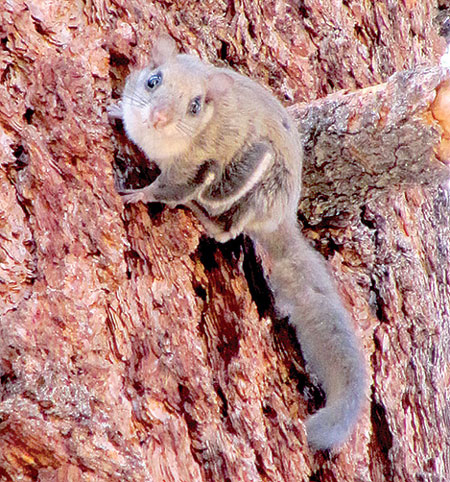
Photo courtesy the U.S. Forest Service
The elusive flying squirrel is the target of the San Diego Natural History Museum and the museum is recruiting “citizen scientists” in its search for the elusive squirrel on the Hill.
For several years, SDNHM has worked with residents in the San Bernardino Mountains to capture photos and videos of the nocturnal creature. Now the researchers, led by Brian Gibson of the SDNHM, and in cooperation with Dr. Jennifer Gee of the University of California’s James Reserve, are turning their skills to Idyllwild and the Hill environs.
The flying squirrel native to the Southern California mountains has not been seen in the San Jacinto Mountains for decades. In 2010, the U.S. Fish and Wildlife Service initiated a study to determine whether the squirrel should be designated as endangered or threatened in Southern California.
In April 2015, the U.S. Forest Service also asked local residents if anyone has seen the flying squirrel in either the San Bernardino or San Jacinto mountains, its normal range.
While Forest Service biologists have been studying the squirrel for more than two decades, its presence in the local San Jacinto Mountains has not been reported for about 20 years.
Last year, the FWS issued findings that the San Bernardino population was safe and not endangered and “… no recent evidence of occupation by the squirrel in the San Jacinto Mountains has been documented.”
The SDNHM project hopes to provide some contrary evidence.
Soon, posters will be seen in town inviting potential citizen scientists to contact Gibson at the museum. He plans a community meeting with Gee next month and will distribute cameras that can record the night-time visits of squirrels and other nocturnal creatures.
Flying squirrels are closer in size to chipmunks than larger native gray squirrels. They are nocturnal and have large flaps of skin that connect their front and hind feet. These flaps of skin allow them to glide from tree to tree. They do not fly in the same way that birds do — no flapping is involved. Their flat tail is used as a rudder to steer as they glide, according to the Forest Service’s press release.
Apparently, the suet and nuts used to attract the squirrels into the camera perspective can attract other animals. In San Bernardino, other species such as fox and bear were recorded along with numerous squirrel visits.
“Participants can upload their data and be part of the research,” said Gibson. The San Bernardino portion had about 30 citizen scientists, he said.
The squirrels are partial to truffles and seeds, and a thick ground cover or duff, according to Gibson.
In San Bernardino, the Forest Service surveyed and studied flying squirrel habitat in the forest, and the SDNHM worked with residents. Squirrels seemed quite compatible with houses and food availability. But weather seems to affect population. The squirrels appear to be sensitive to drought.
Their choice of living quarters tends to be snags and fallen trees. These cavities provide relatively safe daytime residences. In San Bernardino, several individuals and families seemed to prefer bluebird homes if the entrance holes were about ¼-inch larger than normal.
The Southern California flying squirrel is a member of the western flying squirrel species, which is genetically distinct from the northern and southern populations. Its range extends from Alaska to San Bernardino.
Historically, there was a San Jacinto Mountains population. Gee says that the Berkeley Museum has a specimen that was found in Idyllwild in 1908. None more recent have been documented.
Gibson can be contacted via email at squirrels@sdnhm.org.