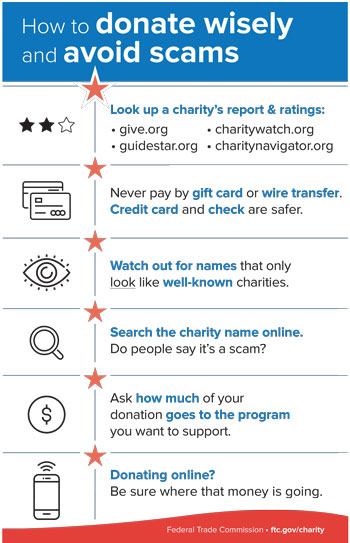
The U.S. Federal Trade Commission released this PSA illustration to help those who wish to make donations make wise decisions and avoid being scammed.
Courtesy Federal Trade Commission
By Colleen Tressler

Consumer Education Specialist

Federal Trade Commission

Disasters and weather emergencies are in the news. Whether it’s the volcanic eruptions in Hawaii and Guatemala or the wildfires in Colorado [and California], it’s heartbreaking to see people lose their homes and businesses to the ongoing devastation. But it’s despicable when scammers exploit such tragedies to appeal to your sense of generosity.

If you’re looking for a way to help, the FTC urges you to be cautious of potential charity scams. Do some research to ensure that your donation will go to a reputable organization that will use the money as promised.

Consider these tips:

• Donate to charities you know and trust with a proven track record with dealing with disasters.

• Be alert for charities that seem to have sprung up overnight in connection with current events. Check out the charity with the Better Business Bureau’s Wise Giving Alliance, Charity Navigator, Charity Watch or GuideStar.

• Designate the disaster so you can ensure your funds are going to disaster relief, rather than a general fund.

• Never click on links or open attachments in e-mails unless you know who sent it. You could unknowingly install malware on your computer.

• Don’t assume that charity messages posted on social media are legitimate. Research the organization yourself.

• When texting to donate, confirm the number with the source before you donate. The charge will show up on your mobile phone bill, but donations are not immediate.

• Find out if the charity or fundraiser must be registered in your state by contacting the National Association of State Charity Officials. If they should be registered, but they’re not, consider donating through another charity.

• To learn more, visit www.consumer.ftc.gov/features/how-donate-wisely-and-avoid-charity-scams.

Similar Posts

  • Don’t Be Scammed: New tax scheme

    They’re at it again… tax scammers scheming new ways to steal personal information and money.

    In the first scenario, identity thieves file a fake tax return and have the refund deposited into your bank account. The thieves then contact you, often by phone, and — posing as the IRS or debt collectors for the IRS — demand you return the money to the IRS. But following the thieves’ instructions actually sends the money to them.

  • Don’t be scammed

    Attorney General Kamala D. Harris has issued a consumer alert warning California businesses to be aware of phishing scams that target the workplace and can lead to data breaches and loss of funds. The scam is commonly called “brand spoofing” or “phishing” because the spam mail sent uses familiar or legitimate-sounding names of companies to…

  • |

    Scams against older adults: reporting to Congress

    By Lois Greisman Federal Trade Commission, Elder Justice Coordinator You might have read media stories about older people losing lots of money to scams. It does happen — and FTC data show that when people over 80 report losing money, the amount they lose is a lot higher than the amount younger people lose. But…

  • |

    Don’t be scammed

    This winter’s heavy rains have left many asphalt roads and driveways crumbling or covered with potholes. That’s made the state fertile ground for a long-standing construction scam: families of unlicensed paving and seal coating contractors sweeping in from out-of-state and taking advantage of unsuspecting homeowners. Friday, March 3, investigators from the Contractors State License Board’s…

  • |

    Scams that start on social media

    By Bridget SmallDivision of Consumer & Business Education Scammers are hiding out on social media, using ads and offers to market their scams, according to people’s reports to the Federal Trade Commission (FTC) and a new Data Spotlight (www.ftc.gov/news-events/blogs/data-spotlight/2020/10/scams-starting-social-media-proliferate-early-2020). In the first six months of 2020, people reported losing a record high of almost $117…