

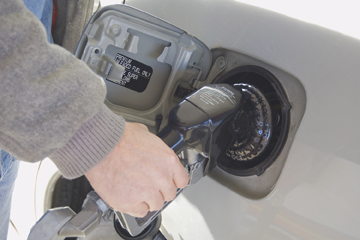
Last month, members of the California State Board of Equalization voted to lower the excise tax rate for gasoline by 6 cents beginning July 1. Since 2010, the “fuel tax swap” law has required the board to adjust this tax rate by March 1 of each year. The excise tax rate on gasoline will be $0.30 per gallon from July 1, 2015 to June 30, 2016. The current excise tax rate of $0.36 is in effect through June 30, 2015.

Drivers pay two types of state taxes on gasoline — sales tax and a per-gallon excise tax. Before the FTW took effect, drivers paid the full sales tax rate (then 8.25 percent) and an excise tax of $0.18 per gallon.

The FTW lowers the sales tax rate to 2.25 percent on gasoline and requires BOE to set the per-gallon excise tax rate, so drivers pay the same amount of state taxes on gas as they would have paid under the prior tax structure.

In addition to projecting sales tax revenue that would have been generated under the old tax structure, the law also requires BOE to review the actual excise tax revenue generated in the prior fiscal year and subtract that from projected revenue for the coming fiscal year. This calculation determines the coming fiscal year’s excise tax rate.

The excise tax on gasoline pays for public road improvements and mass transit. In fiscal year 2013-14, BOE collected nearly $5.8 billion for the Motor Vehicle Fuel Account, Transportation Tax Fund. The sales tax on gasoline primarily funds local government programs.


Similar Posts

  • Supervisors and Sheriff respond to grand jury

    On Tuesday, July 26, the Riverside County Board of Supervisors (Board) voted on staff recommendations in response to a May 11 grand jury report on the administration of prison health care. On May 24, the Board directed staff to prepare the Board’s response to the grand jury’s recommendations regarding Riverside County Mental Health Detention. The Sheriff’s Department filed a separate, but largely concurring, response. Both the Board’s and Sheriff’s responses found many points of agreement with the findings. Differences were generally the result of funding and intra-departmental organizational issues.

  • County seeks opinions on pit bull ordinance

    To help draft an ordinance about controlling and limiting the population growth of pit bull and pit bull-type breeds in Riverside County, the Department of Animal Services has invited county residents to submit opinions in an online survey. The Animal Services web address is www.rcdas.org/home. The survey can be accessed with a click on the…

  • Nestande opens San Jacinto office

    Beginning Wednesday, Oct. 2, Assemblyman Brian Nestande opens a new satellite office in San Jacinto. The 42nd Assembly District covers a large geographic area and the office will make it easier for constituents to communicate with their representative. This is in addition to the Palm Desert and Hemet offices, and the new satellite office in…

  • County losses continue

    The Riverside County Board of Supervisors adopted a $4.7 billion budget for fiscal year 2013-14, which began July 1. The new budget is about $278 million less than the 2012-13 level. However, the board’s discretion applies to only $630 million. This year, County Executive Jay Orr projects discretionary county revenue will grow by $19 million…

  • Groundwater management bills signed

    Last week, Gov. Edmund Brown Jr. signed legislation to strengthen protections of groundwater use in California. The three bills establish a framework for local groundwater management and set timetables to begin implementation. Emphasis will be placed on groundwater basins, which are high or medium priority. Each water basin’s priority must be identified by Jan. 31,…