A Brief History of The Theater
“The first hand puppets were a pair of hands,
no one could agree who was speaking.
Some saw a swan,
some a crocodile.
None saw the king,”
excerpt from Constantine’s third book, Calamity Joe.
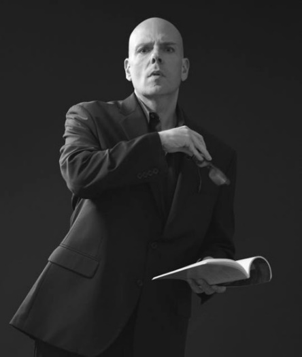
One of California’s most visceral performance poets, Brendan Constantine joins the creative writing faculty at Idyllwild Arts staff this summer and recently granted the TC a captivating interview in the nook at the Gnome.
Author of four brilliant, expertly crafted books of poetry, “Letters to Guns, Birthday Girl with Possum, Calamity Joe and Dementia My Darling,” Constantine’s work has appeared in Field, Ploughshares, Virginia Quarterly Review, Prairie Schooner and many other Journals. He has received grants and commissions from the Getty Museum, James Irvine Foundation and the National Endowment for the Arts. A riveting performer, Brendan has presented his work throughout the US and Europe, appearing on National Public Radio, numerous podcasts include a must see, “The Opposites Game” 2018, on You Tube selected for the next Best American poetry anthology. Constantine, lives in LA, teaches and inspires students at The Windward School and is a 2018 nominee for California state poet laureate.
An unequivocal master of dimensional poetry, Constantine’s eloquence accompanies grifting metaphor, whether whimsical or fractured his words, warp and waif, chiding, mystifying, entertaining yet questioning, delivering shade or shadow with a generosity of lightness rarely achieved within this collective breadth of contemporary topics. Each title deserves its own review I regret, space conscious as I try to be
Constantine’s introduction to language arts established early in life. A child of career actors his imagination was nurtured, his natural sense of whimsy was accepted as unformed frontiers are common in child artists. Everywhere were scripts, poetry, lyrics, the daily soup of life was in a word – words. His predilection for fantasy, shyness and sensitivity set him apart from the fray as he aged out of childhood, grateful as he is to hail from the generation prior to labeling gifted children.
It was assumed Brendan would act. He attended acting schools as a child and into his early twenties, on and off. “It all began at 6 or 7 years old,” he shared, “Lillian Shoven taught in Studio City, I loved it!” Her training was followed by the Van Mar academy.
He spent his teen years on the Hill. “Mom brought me up here in the 80’s and then we found out there was a good school, Desert Sun, whose entry was offered and possible; I attended. I’m so grateful, Idyllwild changed everything. There’s something dreamy here – it’s a charge in the woods, the light is mystical, my oldest memories of Idyllwild are of this theatre of sky, the clouds taking up these sort of calico positions, shading everything and Lily Rock ablaze in light.”
“I wanted it (acting), but never really understood why? I was distracted by the dazzle of the drug scene. I was being groomed by my agent, I even read for a few notable roles in films like Ferris Bueller, ending up as a repetitive extra in Pretty in Pink. And, I certainly didn’t want to wait around doing 10 years of auditions. When I told dad I didn’t want to be an actor, he immediately bellowed, “oh that’s good, you won’t have the rejection and uncertainty.” I’m going to be a poet. “He exploded – oh that’s worse, now there’s no money, constant rejection, certain uncertainty! I decided I’d better get sober; which I did at 23.”
His poem, The Inquisition – found in “Birthday Girl with Possum” delivers startlingly clarity, pristine metaphor. Constantine writes, “But how the hell are we supposed to live with mercy when judgement is exquisite; find us a better drug than laying blame. I know a little girl who has to give one punishment a day to all her toys. She hates it, but they don’t give her a choice.”
“To read poetry is to find a place to languish, to immerse oneself. A poem seems to think as you’re reading it. Sometimes when you read – it becomes an embodiment, whereas prose tells you a story. Poets may even allude to a story, but poetry seeks to embody, give you a feeling, not a moral, or information – a feeling.”
Yet, he confides, “teaching scares me…for a few reasons. I want to be useful, I don’t want to waste anyone’s time – wondering am I truly qualified to impart poetry? He recommends Howard Nemerov’s “Figures of Thought,” then quotes him; “One should never mistake the difference between teaching poetry versus being taught by poetry.”
“Most poetry is intuitive, and I always hope to help my students open or widen their own intuitive insights. In developing the aesthetic sense, I firmly believe there exists some hallowed ground available where an untrained mind can attain the transferal of poetic feeling, outside mainstream education.” Do child prodigies exist in writing, like in music? “You need to have filled a well you can draw from. I’m not saying I know where that well is found; I’m saying there’s a well.”
What else is up for you? “Well, I wrote this poem, The Opposites Game,” he discloses. The poem is vintage Constantine. A remarkable amalgam derives from a writing exercise using a famous line of poetry, in this case Emily Dickinson’s line, “My Life had stood a loaded…gun.” Students must choose word for word an alternate word meaning the exact opposite, rewriting the line. “The Opposites Game” has been included in “The America’s Best Poetry, 2018 Anthology” and the video is on YouTube.
“I spent much of 2017 with a man named Michael Beale, conducting writing workshops for people with aphasia – with poetry they were liberated to use language in a way completely nonsensical yet entirely authentic. Attempts to access their lexicons have been so changed – finding a statement at all is an extraordinary feat. I love watching them find their voices, surprise themselves. When I hear a writer whether they’re 45 or 85, suddenly say regretfully, they’re too old to start writing. Wrong! You’re right on time. What may seem to have been written in 10 minutes took 30 years to come tougher. I’m seeing remarkable transitions at the end of 6 weeks, so much so I’m going back!”
When asked about the role of poetry in social justice? “It’s precarious only if I draw a line in the sand. I run the risk of isolating myself behind that line. How I say it may deliver the message on a wall versus an open field where we can all approach from our unique positions and talk.”
“I do feel, it is a different world over the last 20 years, the advent and market penetration of social media has changed western society. We’ve never had such a theatre of public condemnation and declaration of principle. There is no proportionate forum for restitution, apology and identification. This is why the accused dig in. Maybe it needs to be this way…lets take race relations in the US, a lamentable aspect of white privilege. The timetable of revolution used to die down. Now the megaphone is on 24/7, could be a good thing.”
“Every poem is a message in a bottle, you hope it will be adopted, you hope it will be noticed. After “Letters to Guns” came out I started noticing that social media activity on the poems would follow a shooting. Sometime my poem’s wash up on shore accompanied by the macabre.”
Where do you see poetry going forward? “A pan dimensional world of poetry is on the horizon. There are more creative writing programs available globally than at any other time in history. More people are writing sonnets than at anytime in history. If the larger model of poetry is social conscience, the smaller model would be aesthetic.
The mysterious need for poetry to emerge happens when language hits a wall. It quickly becomes a way to speak to special things in special ways. Therefore, the poet writes for anyone who needs an emotional vocabulary and that is everyone. I have to take that in. If I’m not going to take responsibility for the excitement in my time then I am complicit in the boredom.”
Who are you reading…right now? Terrance Hayes’ new book (refer TC review last week), Kavehakbar’s, “Calling a Wolf a Wolf” and “The January People” by Safia Elhillo and poetry by Ladan Osman, a young Somali American. I go back through Keats to “Ode to a Nightingale,” and I’m learning about the work of Turkish poet, Orhan Veli, and “Open your Mouth like a Bell,” and “Glitter in the Blood,” by Mindy Nettifee.”
He departs for an evening walk, a few more weeks on the Hill to restore his older than letters…soul.
BrendanConstantine.com, Facebook, Twitter, his books are available on Amazon, “The Opposites Game” 2018 is viewable on You Tube. Holly Parsons can be reached at holly@towncrier.com