Eighty years ago, Ernie and Betty Maxwell sat in the attic of their Idyllwild home piecing together a newspaper.
The first Town Crier was four pages long, typed and mimeographed, with artwork by Ernie and, in the issues that followed, headlines and bylines drawn by hand. It was a small operation made for a small mountain community — a way for “Hill folk” to know what their neighbors were doing.
A lot has happened since 1946.
The paper grew. At its height, up to 20 employees and contributors helped put it together. Owners changed, editors changed, technology changed and eventually the way people got their news changed altogether.
Today, nearly anyone with a phone can announce an event, advertise a business or report what they saw on one of Idyllwild’s many Facebook groups.
Once, as editor David Jerome puts it, getting the word out meant pasting a flyer on every bulletin board or getting it into the Town Crier. Advertising helped support the newspaper because businesses needed the newspaper to reach Idyllwild.
The internet changed that equation. Why pay for access to an audience when you can post to it yourself?
But something was lost in the exchange.
There is no editor of Facebook.
There is no journalistic credo governing a Facebook group — no one institutionally responsible for checking whether a claim is true, sourcing it, contextualizing it or deciding whether it deserves amplification. For Jerome, that responsibility is still at the heart of the job. Facts need sources. News needs context. The goal is to remain tuned to the human events of a small town without simply becoming its gossip sheet.
That job can take some unusual forms.
On a recent afternoon, Jerome was at his desk deciphering a legislative bill and translating it into something regular Hill folk could understand. Meanwhile, the phone kept ringing. There were garage-sale ads to organize, stories to edit and people walking in to report their own breaking news.
And inside the Town Crier’s small office at The Collective, three people are now doing the work that once required as many as 20.
Mike Ferro and Corey Pickett took over the Town Crier in September 2025 and are only beginning to understand the size of the thing they inherited.
For Ferro, that has meant juggling the weekly act of publishing with the less visible machinery required to keep a newspaper alive. Printing alone costs roughly $700 every week. Getting those papers delivered costs even more. With advertising no longer supporting local newspapers the way it once did, memberships and direct community support are increasingly essential.
Abandoning the physical newspaper would mean surrendering something fundamental about what the Town Crier has been for eight decades. But analog nostalgia only explains part of the paper’s strange durability.
A significant portion of its readers no longer live in Idyllwild at all. They once did. For them, the Town Crier remains a tether to the mountain. A way of knowing which businesses opened, which neighbors did something remarkable, what local government is deciding and what is changing in a place that still feels like theirs.
For others, a printed newspaper offers something increasingly unusual: a way to know what’s happening in town without joining Facebook or asking Meta to mediate their relationship with their community.
The challenge for the new Town Crier is figuring out how an 80-year-old institution fits into that new landscape.
Pickett initially thought some of the answer might lie in email marketing. Instead, she discovered that Idyllwild still responds remarkably well to something much older: meeting people face-to-face and knocking on doors.
In that sense, the Town Crier has come full circle.
When the Maxwells produced their first issue in 1946, they stayed up until nearly 4 a.m. completing the layout, printed roughly 250 copies and gave them away to local boxholders. Then they waited around the post office to see how people reacted. When someone told them they wanted to subscribe, they made another.
Those early years weren’t exactly easy either. Winter storms could turn simply getting the paper into town into an expedition. The Maxwells later recalled hauling issues by sled and fighting their way back up the mountain through snowstorms.
Keeping the Town Crier alive, it seems, has always required a certain amount of unreasonable determination.
Under its new leadership, the Town Crier has hosted community gatherings including a holiday party at Middle Ridge Winery, a movie night at the Rustic Theatre and a birthday celebration honoring Marshall Hawkins. Membership is evolving beyond simply receiving the newspaper, with community gatherings and benefits from local businesses becoming part of the effort.
The idea is not merely to sell access to a publication, but to build a community around one.
The people putting that publication together are a small cast.
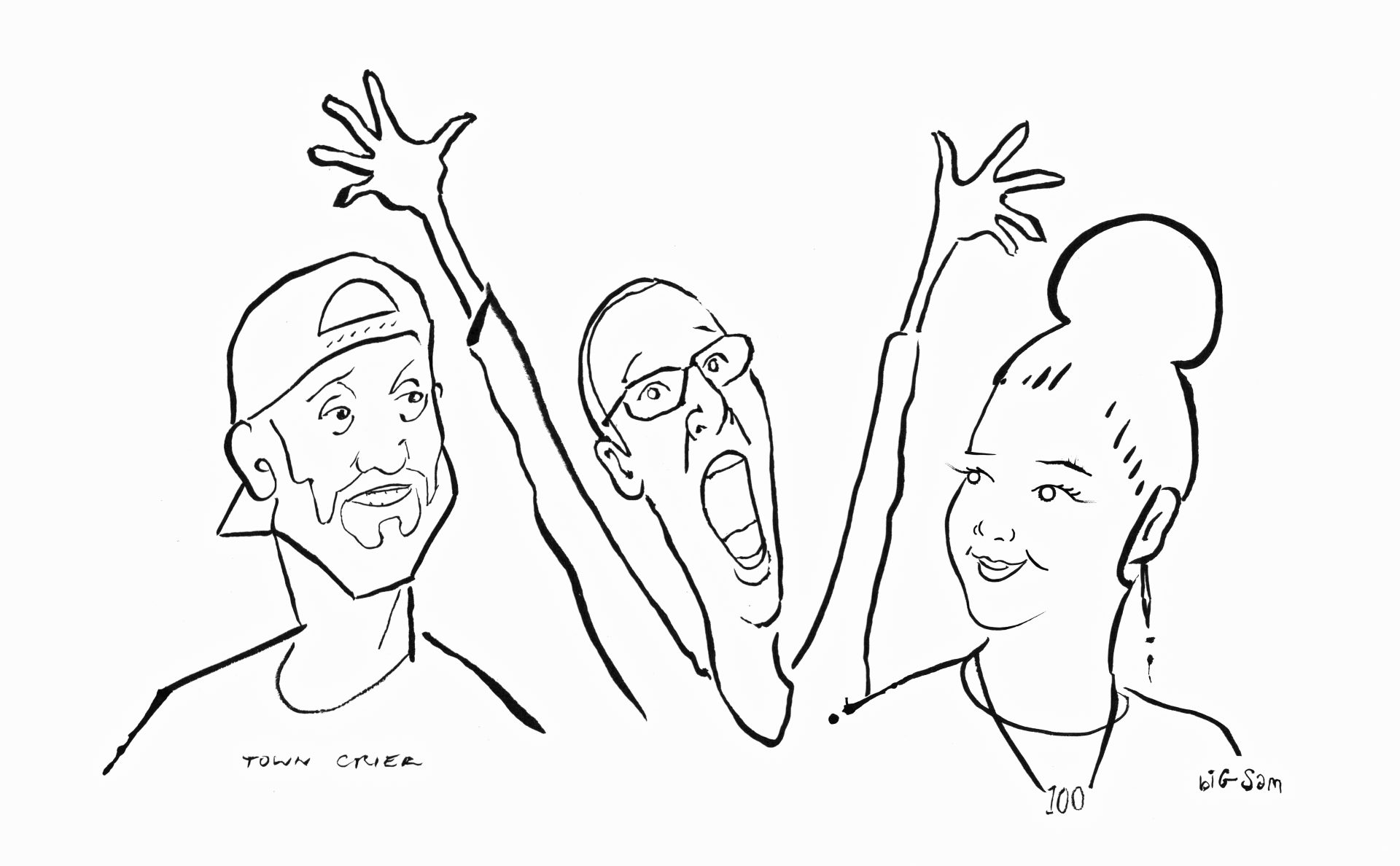
Beyond the three-person core, longtime correspondent J.P. Crumrine continues reporting on local politics, community events and regional issues, while Sam Markus contributes illustrated profiles of the Hill’s people, businesses and events, along with the weekly Local Man comic.
Asked to imagine the core Town Crier team as the crew in a heist movie, Jerome didn’t hesitate.
Ferro is “the muscle,” the IT guy, and the boss.
Picket is the getaway driver — and, according to Jerome, an artist at “keeping it 100.”
Jerome volunteered himself as comic relief. He looks worried at the suggestion that he might be the “mastermind.”
The joke may be closer to the truth than any of them intended. Keeping a small-town newspaper alive in 2026 requires a little scheming.
It also requires reinvention.
Ferro wants the paper to move away from relying on the sensationalism of accidents and catastrophe and further toward the people who make up the community. Jerome’s job is to curate those stories responsibly — to distinguish news from rumor and community interest from gossip. Picket has taken on the equally daunting work of making sure the newspaper has a community willing to sustain it.
It sounds surprisingly similar to what the Maxwells set out to do.
The paper they assembled in 1946 did not survive by remaining unchanged. It grew, moved, expanded and contracted. Now, approaching 80, it has become small again.
Three people at The Collective. A few contributors. A printer bill every week. Members willing to keep paying for something much of the rest of the country has decided it can live without.
Not because print is economically sensible.
Not because everyone desperately needs a newspaper.
But because Idyllwild would be different without one.