Idyllwild residents have been noticing the activities of contractors working for Southern California Edison (SCE) as they perform activities related to the local power grid.
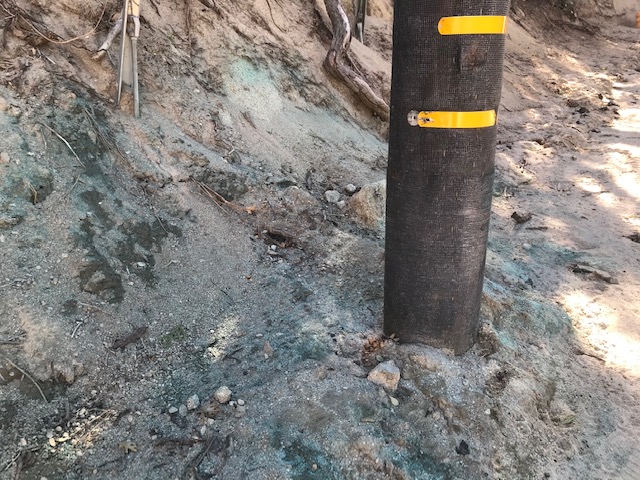
In addition to trimming and cutting down trees, these contractors have been spraying herbicide around power poles as weed abatement. Complaints have been lodged regarding this mysterious green spray we have been seeing around poles, sometimes in areas in which no weeds grow.
For instance, a pole on Tahquitz View Drive had been sprayed in spite of the absence of any vegetation on the steep, bare mineral soil shoulder and bank, for many yards.
Local Ernesto Alé reports that one of these contractors, working for Pacific Weed Control, sprayed a pole in front of his residence and then attempted to open the gate and come onto the property to access another pole not actually on his lot. The ensuing interaction included his taking a photo of the data sheet for one ingredient of the mixture that was being sprayed (indaziflam, of which more later) and a photo of a door hanger, with the comment “weed abatement/fire prevention checks.” Since then, a second hanger has appeared with the request to leave the gate unlocked and keep the dog inside.
SCE Public Information Officer David Song answered some questions about this type of activity and provided background on the utility’s wildfire mitigation and resiliency efforts. Apparently, contractors must have permission to spray beyond their easement along public roads.
DS: “That is part of our vegetation management activities. To reduce the tinder around poles. Herbicide is one small part of this mitigation. Herbicide is used where approved to treat the cleared 10-foot radius around the pole to prevent regrowth. Herbicide must be approved by SCE Environmental Services Department and the customer prior to application. All herbicide used must be registered with California Department of Pesticide Regulation and must be used in accordance with all applicable state, local and federal regulations, as well as all label requirements. The 10-foot radius exceeds our easement, that’s why we need permission.”
TC: “Can you update us about the general program of activity relating to wildfire risk?”
DS: “Next Friday we will be filing our annual wildfire mitigation plan update, with Office of Energy Infrastructure Safety (OEIS.) There are a number of aspects of the filing.
“Grid design and system hardening work: Includes activities like installation of covered conductor/insulated wire, 11,000 miles in 2022. Fire-resistant poles, whether composite or wooden with fire-resistant wrap. These reduce damage to poles during an emergency, allowing us to safely and quickly restore power to customers. There are a number of protective engineering devices, for example, fast-acting fuses. These interrupt current more quickly. In power-line-down situation, this reduces risk of ignition. About 350 of those scheduled across our high fire risk service area; 27% of our service area is high fire risk, including Idyllwild.
“Risk Informed inspections: While we are doing work, we are inspecting all our equipment, like a doctor doing an annual physical. This year we will inspect 150,00 pieces of distribution equipment (poles and lines), 16,000 bulk power assets (long distance remote, steel towers, etc.) Ground based risk informed inspections can only see so much; they might not be able to see the tops of transformers, power lines insulators. Aerial inspections augment this. We use both helicopters and drones. These things take high resolution photos that expert personnel can analyze.
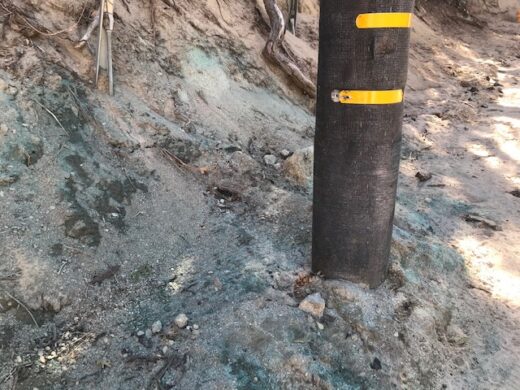
PHOTO BY DAVID JEROME
“We are continuing efforts to inspect, trim and remove trees to prevent vegetation from coming into contact with electrical equipment and sparking a fire. Tall trees that could potentially fall into lines that are beyond our pruning zones are also assessed and mitigated. We inspect 1.5 million trees annually and prune 900,000 across our service area. Out of those, 750,000 are in high fire risk areas. We plan to also assess hazard trees on at least 330 circuits (circuit could serve a few hundred to 10,000 customers) and remove or mitigate if deemed unsafe. People should know that if there are trees around high voltage lines, we will take care of it. If they see something they should call us at 1-800-655-4555.
“We recognize that public safety power shut-offs [PSPS] can be a hardship on our customers . We use PSPS as a tool of last resort. We will continue to reduce the size, frequency and length of PSPS events. All these other efforts help us reduce the scope and frequency of PSPS events.”
Returning to the subject of the herbicide, the data sheet Alé took a photograph of is for “Esplanade 200 SC,” containing the active ingredient indaziflam, produced by Bayer. (Chemical name N-[(1R,2S)-2,3-dihydro-2,6-dimethyl-1H- inden-1-yl]-6-[(1RS)-1fluoroethyl]-1,3,5-triazine-2,4-diamine.)
It functions by interfering with the biosynthesis of cellulose, the building block of plant structure. It is a pre-emergent herbicide, meaning it is used to prevent the sprouting of vegetation, not kill existing plants. This allows spraying near ornamental plants and in places like golf courses, nurseries and Christmas tree farms. It is intended to have lasting effects, preventing new growth for eight months, and “becomes rainproof within 30 minutes after application.” It was first approved for use in the U.S. in 2010.
An email discussion between Alé and Jennifer, a Pacific Weed Control training and safety manager, highlighted Alé’s concern for the safety of wildlife, his pets and his edible garden (which is near the spray area.) This was countered by Pacific’s insistence that the chemicals used have “very low toxicity levels,” and, ”It is in fact why we use these specific chemicals.”
By phone, Alé explained to the Crier that the pole is “visited” (and sniffed) by his dogs whenever they go for a walk. The data sheet for indaziflam does include the results for test on rats, rabbits and dogs, with the typical horrible results when doses are high enough: damage to brain, nerves and spinal cord, resulting in neuropathy and seizures. Here it is only fair to underline the amount an animal must ingest for these effects to be apparent.
These sheets include two doses: no observable adverse effect level (NOAEL) and lowest observable adverse effect level (LOAEL). The animals are divided into groups, each group being fed a different daily dose by body weight. The numbers are given as milligrams per kilogram per day (mg/kg/day). With some animal tests there is different toxicity for male and female (M/F) animals, and so an M/F is added to the data.
The NOAEL and LOAEL given by the EPA for indaziflam are 7.5 and 15 mg/kg/day for dogs. For a dog of 40 pounds (18 kilos) the LOAEL comes out to 270 mg daily, just over a quarter of a gram. A daily dose half that, under laboratory conditions and given to healthy animals, produced NOAEL after a month. At the end of the month, all animals are “sacrificed” (the term of art used in the data sheets.) PETA reports that each year, 110 million lab animals share this fate.
Pacific Weed Control did not respond to our questions and request for comment by press time.