Four more Goldspotted oak borer-infested trees have been identified in Idyllwild. When authorities identified the first infested tree here in November, they expressed hope that it was an isolated incident. Authorities no longer believe the outbreak is limited.
Since tree one was on Highway 243, it appears to have been almost certainly infested from firewood transported from San Diego County and perhaps the imported firewood location was near the infested tree.
Trees two and three were identified on Jan. 19, one near Mountain Top Liquor and one at Town Hall. Last week, authorities identified four more infested trees, Three are along Highway 243 between tree one and tree two. The seventh tree, which CAL FIRE Forester Gregg Bratcher called a monster oak, 147 inches in diameter, is on private property on Marian View Drive, and was identified by an Edison employee.
At this point, although Dr. Tom Coleman, U.S. Forest Service entomologist and lead Goldspotted oak borer scientist, has begun to talk about insecticides, both topical and systemic. Those candidate insecticides have never been used in the field against California Goldspotted oak borer. If used, application costs would not be small, and results could be short-lived, long-lasting or ineffective, depending on success of application mathods. Another potential control agent, importing a Goldspotted oak borer predator from Arizona where this particular oak borer is native, waits years of scientific trial and investigation to ensure the importation would be effective and have no unintended consequences.
At present, the surest way to stop the insect’s spread is to remove and grind the tree, tarp the firewood (using window screen that won’t deteriorate with the elements), or debark the firewood and arrange to have the bark taken to the grinding station.
Removal stops spread, but removal is also expensive, depending on the size of the tree, location near a home. camp or park. And should the Idyllwild outbreak grow to the extent of the catastrophic bark beetle crisis in the early part of the last decade, the issue becomes for public and private landowners, who would bear costs of removal?
Bratcher said he is working on obtaining county grants that could assist private landowners, much like the Forest Care program has helped thin parcels. He also mentioned that Southern California Edison, much as it did during the bark beetle emergency, could remove infested trees that threaten its power lines, although that has not yet been agreed with SCE.
CAL FIRE, University of California, Riverside, and the Forest Service are conducting field exercises to train professional responders, public agencies, volunteer groups and private citizens on how to spot Goldspotted oak borer infestation in Hill oaks.
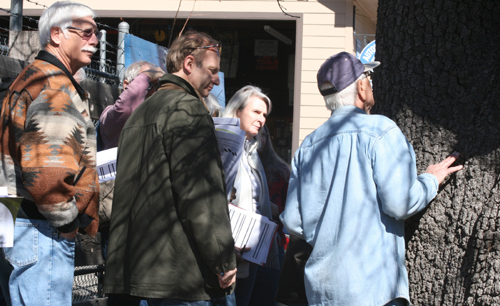
On Tuesday Feb. 5, Bratcher, UCR GSOB Program Coordinator Kevin Turner, and Dr. Tom Scott, UCR GSOB scientist conducted a field training for about 30 members of the Mountain Communities Fire Safe Council’s Woodies, the Idyllwild Garden Club, and some CAL FIRE personnel in a two-hour spotting exercise. By spring, CAL FIRE wants as many citizen-scientists on the ground in the Idyllwild area as possible to assist in GSOB tree identification. Spring is when a larger outbreak is likely to occur.
If anyone has a tree that they feel looks as if it could be infested, call the new GSOB Hot Line at the Resource Center on Franklin Drive. That number is (951) 659-8328. Bratcher stressed that all potential oak borer calls must come to the Resource Center number, so that they are logged in. “We need to have a protocol and stick to it,” he said. “Go through the mechanism, the GSOB line.”
Volunteers for citizen scientist GSOB training, to act and report as civilian spotters, should call the Mountain Communities Fire Safe Council at (659) 659-6208. CAL FIRE has smartphone apps that could be used by field personnel to identify the oak borer infestation.
Many in the Tuesday training discovered how hard it is to identify the “D” shaped GSOB exit holes in Hill black oak. Scott explained that the trees most affected in San Diego County are not black oak, and the exit holes are larger and easier to spot. In black oak, with darker bark striations, the smaller holes are harder to see.