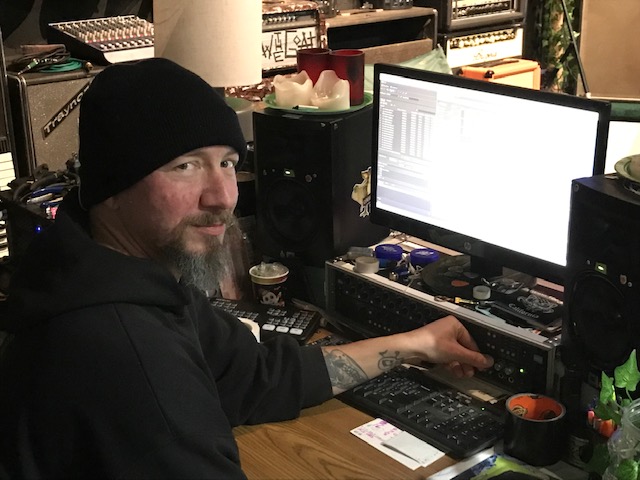
Brian Parnell has taken a circuitous journey to end up an Idyllwilder. Like so many of us, a chance taken paid off in the satisfaction that comes from being part of a community that supports self-expression. Readers with an ear for the pulse of 21st century rock know him as one of the founders of Throw the Goat, a local band that achieved global success. His new venture is AudioWild, a venue and recording studio in “downtown Idyllwild” serving musicians and other audio dreamers and bringing together fans and performers for intimate concerts that rock the house without keeping the neighbors up. The Town Crier sat down with Parnell recently to get his origin story on the record.
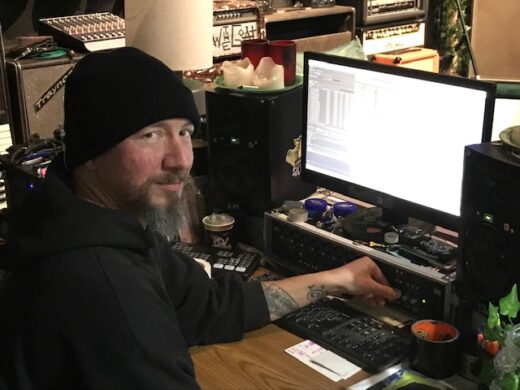
PHOTO BY DAVID JEROME
TC: What is your backstory, how did you come to Idyllwild?
BP: I graduated from Montclair High school in beautiful Montclair, California in the year 2000. All through middle school and high school my friend Tyler Campbell, we worked on music together, incorporating our home computers into the recording process. At the time the OS was Windows 95. Windows 95 came with a program called Sound Recorder
TC: That was good enough to get you started?
BP: That was pretty cool, you could mix files together, reverse it, speed it up, slow it down. We started sampling drum beats from whatever CDs our parents had in their collection, ZZ Top albums, things like that. After we graduated I ended up getting a gig as a guitar technician. It’s worth noting that Tyler now works for Space X and plays banjo in a two piece band called Giving Up The Ghost with his wife Marie Regalado. I recorded a few of their songs which I think will be released later this year.
TC: You got a job with a touring band?
BP: A band called theStart. I was a fan. The band was comprised of members from bands I was into in the mid to late 90s. They formed this, in my opinion, super group. In those days there were message boards on bands’ websites where you could interact with bands and chat with other fans around the world. We had a little tight-knit unit of fans of this band, and I ended up meeting them at the NAMM (National Association of Music Merchants) trade show. As a plus, for the teenagers in attendance, there’s a lot of big celebrity musicians to sign autographs and stuff, so i was pretty stoked on that and brought my little CD booklet for them to sign. They saw my badge; at the time my dad had a guitar and amp business in Upland, California, I’m pretty sure he only opened that shop just so he could get a NAMM membership, I didn’t understand why he was so excited about it, but I definitely got it after attending.
So they were looking at my badge and it says “Parnell Guitar and Amp Repair,” and at the time I wore a beanie, obnoxious neon green, that said “puke” on the front, a nickname I got in my teenage years, definitely earned it. They were like “Wait, are you the ‘Puke’ from our message board?” “Yeah, that’s me.” “And you know how to repair guitars and stuff?” “Yeah.” At a weird point in my life where I’d quit my job, and I’d dropped out of college, and I didn’t know what the hell I was going to do I got an email asking if I wanted to “roadie” for them for one show in Santa Ana at the Observatory. I did, I was a drum tech for that show and it worked out well, and they asked if I wanted to do a one week tour with them in a van and trailer. I was like “Sure.” That worked and they were like “OK, we’ve got two months that we’re doing with Sugar Ray in a tour bus doing arenas.” This was in 2001, like the height of Sugar Ray’s career. I was a touring guitar technician for 10 years. For theStart, and then I moved to England for a little bit, I was working for a band out there. Came back to the states. I ended up in Idyllwild … I came back from a tour in 2005. That year we toured with Garbage and a band called Gold Finger. My buddy Tyler, I’d been talking with him, and his parents moved when we graduated. I was like, “Where the hell they moving?” “Some little mountain town, Pine Cone or something.” It turned out they had moved up here and opened Merkaba, the purple tea shop. Tyler moved up here for his own personal reasons. He was telling me about the town and was like, “Hey there’s a lot of artists, a lot of musicians, we can work on music like we did in the old days, what do you say?” At the time I was in Niagara Falls, New York. I called his bluff and moved 3,000 miles and lived in his laundry room for a few months until we found a place with enough bedrooms.
TC: You and your friend found a place and settled in to finding things you could do up here?
BP: We already knew how to record music. We started messing with more modern stuff that was still free and available, honing our skills. It was the same situation we were into in high school, a project with two guys and a computer that you couldn’t recreate live, so we never really got a band going, per se. But I always wanted to be in a band. Then 10 years on the road … being a fly on the wall for the collapse of the music industry, and (the rise of) Napster and iTunes. When we got back from that first tour, like four months later, the first iPod came out, and iTunes. So, everything completely changed. The band I was touring with, we were in tour buses and stuff, and the next thing you know it’s a van and trailer again, and they have to go back to their DIY punk rock roots. So, I got to learn how the whole label system works, and how the DIY punk rock scene works, and then go to the UK and learn their whole system. Then I end up in Idyllwild after a marriage that fell apart and not knowing what to do. A buddy of mine up here was like, “Hey, some of us are getting together to jam, do you want to play guitar, we hear you’re a guitarist.” I’d known them for years and never played for them. I had to get a guitar and amp out of storage form my ex’s place. We got together in a little two-bedroom shack in Pine Cove with shag carpet. I’d only come out to California for a two week visit to see what I could salvage of my life, figure something else out. The only rule was that I didn’t want to do anything that I had done previously. Jamming with these guys the vibes were super cool. I was like, “Can I just stay here and sleep on the couch and we can do this?” It was like, “Yeah, no problem!” My two-week visit ended up being … 12 years. That ended up becoming Throw the Goat. None of us anticipated how popular we were going to end up being with the young folk in town.
TC: It worked out.
BP: It worked out really well. Our first show was so packed we couldn’t fit any more people in that building; there were people on the sidewalk looking through the windows. It was crazy. At Bone Daddies, where Mountain Maniacs Arcade is now.
TC: You hit a nerve or filled a need?
BP: For sure. Our group, our age group had only just started reproducing and getting married and that sort of stuff. Everyone was looking to party it up; we were a party kind of band for sure. Those early glory days were definitely something else. Then it became work. Our first tour was a UK tour. I was so glad because I had always wanted to have a band, now I was able to apply all this stuff I had learned for a decade: OK, this is how you work with a publicist, this is how you do this, this is how you do that. There’s no way we would have been able to book a UK tour.
TC: You knew the details, the business, the technology and the drudge work, too?
BP: The ins and outs, I’d been soaking it up like a little sponge.
TC: Your first tour in the UK, it’s great for a small-town band to hit the world that way.
BP: Everybody was so excited for us and we just stepped over all the other bands in the scene. We gave people the impression we were this really big professional band right out of the gate. We were still very, very green, wet behind the ears, with delusions of grandeur …
TC: But you could put something out there.
BP: We ended up coming up with something that people were interested in and strangely enough, that first album, we called it “Black Mountain,” still to this day, when I check all our streaming numbers, it’s still one of our most popular releases. Even though that was over 10 years ago.
TC: You recorded it yourselves?
BP: Demo recorded at “Goat House” with Michael McDole, no longer with us. The album — (we) found a place in Temecula called The Vault. A venue, store, rehearsal place, recording studio. Engineer Alex Papas — I met in 2002 on the Warped Tour, one of the many connections I was able to incorporate in the early days of the band. We learned a lot being in the studio with Alex. It’s kind of hard for me to listen to the first album; we weren’t all that prepared to go into the studio and there’s a lot of ProTools trickery…
TC: Only you know what really happened?
BP: Yeah. Everybody else was super stoked and it took so long to do it. Afterward, the album’s out and anyone I’m riding in a car with … the first thing they would do is put on “Black Mountain.” I’m like, “This is the last thing I want to listen to,” but everybody’s so excited, you don’t want to be a jerk (laughs).
Parnell went on to describe the inevitable “life takes over” and the band “started losing people one by one.” Once the band started going through a revolving door of members it lost some local interest.
Continued next week.