
By JP Crumrine
Correspondent

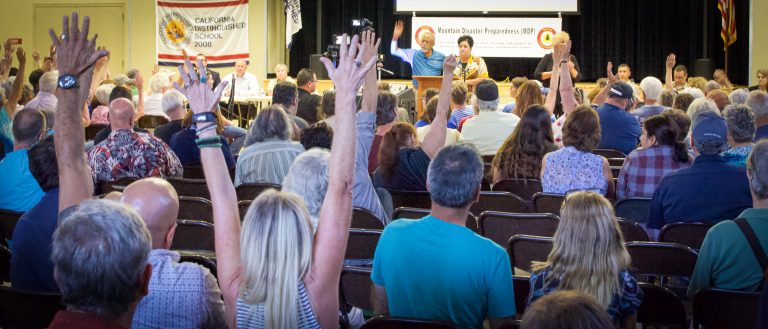
Warning Coordination Meteorologist Alex Tardy at the San Diego office of the National Weather Service (NWS) was in Idyllwild last week. As Mike Feyder, Mountain Disaster Preparedness (MDP) president, said Tardy is a friend of MDP and has spoken in Idyllwild several times beginning in 2015 and last appearing here a year ago.
“He’s here to give us a heads up on what to look for this winter and how we should prepare,” Feyder said in his introduction of Tardy.
During the evening, Tardy discussed last week’s rain, the 2023-24 winter weather and weather forecasting in general.
Tardy began with a comparison of his work to MDP: “We are involved in preparedness, warning, actions and mitigations.”
Prior to departing for Idyllwild, Tardy had posted online a discussion of Wednesday night’s rain and a forecast for the weekend precipitation. He noted that the NWS’s original forecast for the Wednesday rain was between .7 and 1 inch on the Hill communities.
The actual amount varied around the Hill. To the north, Poppet Flats received 1.08 inches of rain and Vista Grande was close at 0.94 inches. Dutch Flats had 0.87 inches and Idyllwild Fire Station recorded 0.84 inches. Further south, Keenwild Ranger Station got 0.73 inches and 0.55 inches fell in Anza.
The weekend rain forecast was for more rain, but less than a quarter of an inch. Sunday morning, NWS reported rainfall on the Hill ranged from 0.16 of an inch at Vista Grande, 0.13 inches at Dutch Flats, 0.08 inches at both Idyllwild Fire Department and Keenwild Ranger Station.
He expected temperatures to rise with mild Santa Ana winds Monday and Tuesday.
“We can predict well in six to 10 days pretty accurately,” Tardy said with pride, then lamented that, “Forecasting beyond 10 days is almost impossible. Largely because the storms don’t exist on the horizon.”
To emphasize his point, Tardy noted that during his presentation last year, he discussed the drought that was in year three and the general winter conditions but there was no mention of a mega snowstorm at the end of February or a hurricane (Hillary) in August. These two events were unseen until much closer to their origin.
Long-term weather forecasters rely on historical records and recent trends. But the specificity of the forecast depends on the conditions in the present.
One of the most important variables is the temperature of the oceans, which then affects the atmosphere. Wind and pressure patterns change. This can alter the jet stream, further north or south, and how much ocean moisture it can transport over land. Thus, this redistribution of heat and energy from the ocean affects the weather.
When the eastern Pacific Ocean around the equator warms significantly, this phenomenon is called El Niño. And when those waters cool significantly, it is described as a La Niña.
El Niño conditions typically, but not always, generate wetter winters in Southern California. Both the winters of 1982-83 and 1997-98 were El Niño periods and produced the two wettest winters. La Niña conditions typically create the opposite weather patterns, dryness.
But these historic patterns are always good indicators of what will happen to weather conditions in any specific year. For example, the winter of 2015 was a super El Niño, “but Southern California missed every storm that year. It was the strongest El Niño on record but one of the driest years in Southern California,” Tardy related.
The winter of 2023 was another good example of actual weather contradicting the La Niña mold.
La Niña ocean conditions existed, California was in the third year of a drought. Today, the state is essentially drought free because last winter was one of the wettest ever. In the 2022-23 rain year (from Oct. 1 to Sept. 30), Idyllwild had 45.5 inches of rain. The 30-year average is 24.5 inches.
“It was the fourth wettest year. It was two winters in one,” Tardy said.
This past summer was one of the hottest ever, especially in the desert communities, as El Niño formed. But in August, Hurricane Hillary developed and dropped a bucket of rain over the Hill and in the desert, where some areas are still recovering.
“Over the past several years, we’ve had La Niñas that are really dry and La Niñas that are really wet. We’ve had a little of everything. El Niños have been the same, some wet and some dry,” Tardy stressed. “But we’re going into an El Niño.”
Just two weeks ago, NWS’s Climate Prediction Center reported, “Based on latest forecasts, there is a greater than 55% chance of at least a ‘strong’ El Niño … persisting through January-March 2024. There is a 35% chance of this event becoming ‘historically strong’ for the November-January season … In summary, El Niño is anticipated to continue through the Northern Hemisphere spring with a 62% chance during April-June 2024.”
Given the projection of an El Niño pattern this winter, what should we expect? Tardy again stressed the difficulty of long-range weather predictions. “After Thanksgiving, which should be warmer than normal, we’re getting all sorts of signals.” There is a potential for a cold storm, “but we don’t know if it will go to Southern California, Salt Lake City or further north,” Tardy added. “The models keep changing.”
Which is another important fact about long-range forecasts.Meteorologists have nearly a dozen models to forecast future weather based on past conditions and results. But multiple models can generate different outcomes because they use different variables or give them different weight.
For example, Tardy showed a slide with December’s forecast from 11 different models. Most predict above-average precipitation next month, but not all of them, in particular the NASA model prediction is for a dry month, maybe very dry.
He suggested that some of the ambiguity may be if the period is separated into the individual months from December to February. Those forecast a wet, perhaps very wet, December and January, while February may be dry with little precipitation, which will return some in March.
Meteorologist Dr. Daniel Swain, climate scientist at the Institute of the Environment and Sustainability at the University of California, Los Angeles, has offered similar thoughts about the approaching winter. “The clearest prediction is for a wet winter. Temperatures should be warmer than average for winter overall. But there is a modest but noticeable tilt in odds of more precipitation. So most likely a warm and wet winter; the next likely is for an average winter.”
So as of Nov. 16, the NWS service forecast for this winter is a wet and warm winter period. However, Tardy and Swain both emphasize that these forecasts are simply the odds of a difference from average so their “confidence level is not high.”
For example, the NWS forecast for Southern California is a 40% to 50% chance it will be wetter than average. However, that also means there is a combined 60% chance that it will be drier than average or just average.
While weather forecasting has changed and improved since the “Farmer’s Almanac,” Tardy feels the long-term forecasts have not significantly improved in 30 years.
But that may be changing. In a “Science” article published Nov. 14, it was reported that Artificial Intelligence is quickly becoming a faster and better weather forecaster.
According to the author, Paul Voosen, “Artificial intelligence (AI) is now spurring another revolution within numerical weather prediction, as the field is known. In mere minutes on cheap desktop computers, trained AI systems can now make 10-day forecasts that are as good as the best traditional models — and in some cases even better. The world’s top weather agency, the European Centre for Medium-Range Weather Forecasts, has embraced the technology: Last month it began to generate its own experimental AI forecasts.”