By Art Conner
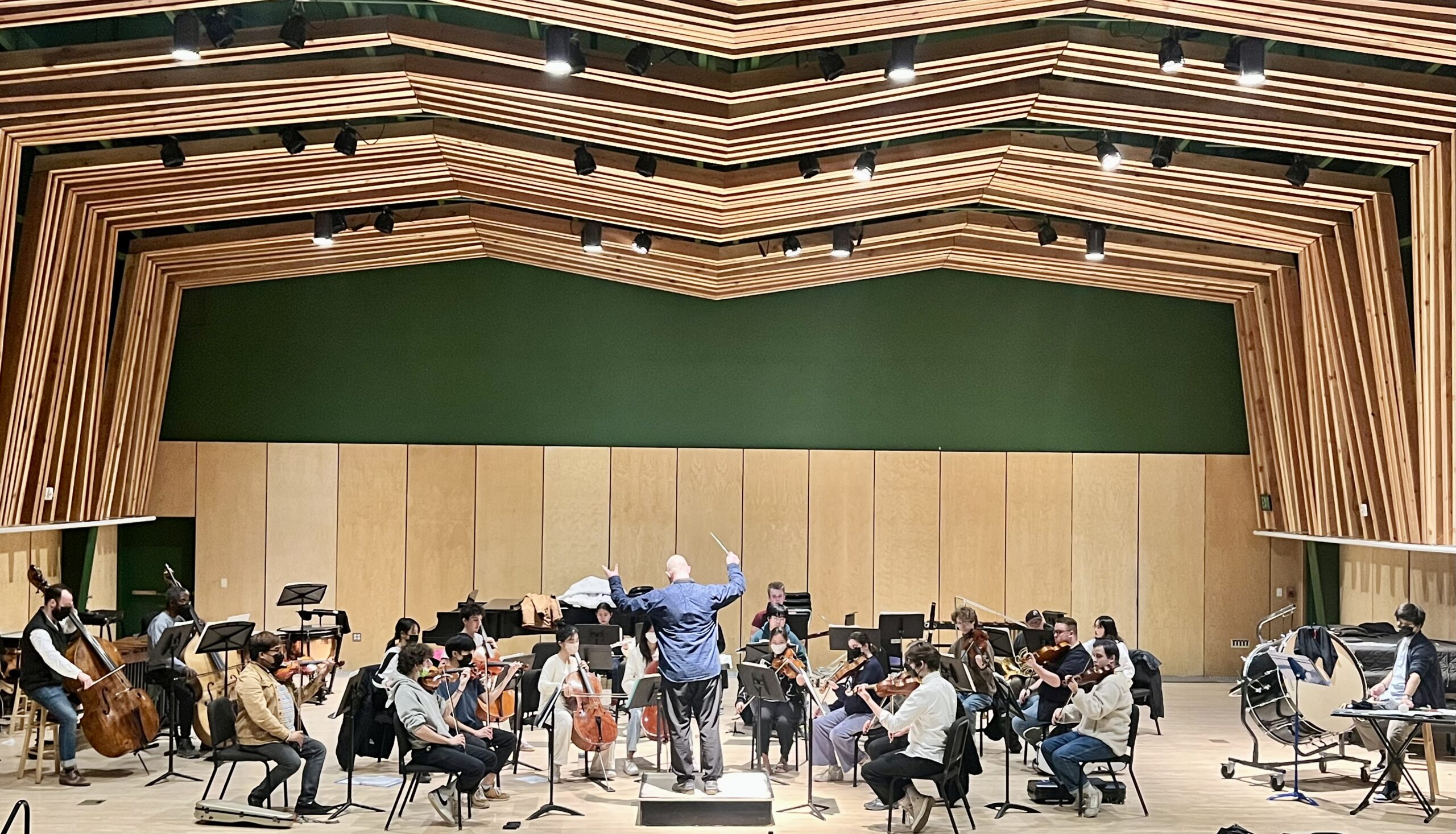
Apropos of an overall, underlying theme for the second Fall Concert offering of the Idyllwild Arts Academy Orchestra Saturday night at Lowman Concert Hall, both the Orchestral Director Daniel Bassin and Music Department Chair Kai Potts-Smith presented the heading “The Healing Power of Music — Vibrations Across Generations” at the top of the printed program. What ensued was a demonstration of the relative sonic impact of pieces from the mid-18th century to the latest compositional trends, with a surprise call for an event involving audience participation. The proceedings were introduced, however, with a short tribute by Mr. Bassin to the area’s Native American Cahuilla band, as respectful of their contributions to the soundscape and the natural environment.
PHOTO BY JOEL FEINGOLD
Following this spoken prelude, the scaled-down component of some 27 performers gave forth an enthusiastic rendition of Estonian composer Arvo Part’s “Fratres” (in the composer’s own chamber orchestral arrangement). Bassin’s interpretation was distinctly on the mark for solid string sonority, together with a precise keeping in tempo (equally necessary as in the large orchestral version) which was perfectly punctuated by the bass drum and tam-tam combination from percussionist Uchyu Ono, providing possible additional references to the Cahuilla nation in a reverential mode (“Fratres” being translated as either “brothers” or “brethren” according to one’s personal religiosity). Continuing in solemn, meditative mode, Gabriel Faure’s orchestral “Pavane” gave out further evidence of the ensemble’s string quality, and the release of more than competent playing in the wind section.
The program’s first half then concluded with the three-movement “Symphony in G Major” by the French composer of African descent Chevalier de Saint-Georges, a not-so-often heard bit of classicism, veering in thematic material between middle-period Haydn and early Mozart, but containing very little of the typical French galanterie of the period. What was brought forth from this unusual excursion was a welcome sound that the work deserved — clean, level-headed and well-reasoned approaches on every player’s part.
After a short intermission, the “Concertino for Clarinet and Small Orchestra” of Ferruccio Busoni was put forth. The soloist, clarinetist Rita Lai, rushed out of the wings with admirable eagerness, and played the 10-minute work as if it were the companion piece to Claude Debussy’s “Clarinet Rhapsody” — perhaps with an understanding of the two works’ similarities; after all, Busoni admired Debussy, and visited both Paris and London during the composition of the piece, following World War I’s armistice and as a respite from his work on the opera “Doktor Faust.” Whether intentional an homage or not, Ms. Lai’s interpretation clearly indicated the work’s importance in clarinet literature, as well as her particular talent.
There followed an arrangement (or “realization”) of the last contrapuntal section of Johann Sebastian Bach’s “Art of the Fugue” (the “Fugue with 3 Subjects”). Bach’s works always provide grist for the compositorial mill (from Schumann and Liszt through Stokowski, Schoenberg, Malloch and beyond), and this foray into one of Bach’s unfinished pieces was no different. Utilizing minimal woodwind accents as necessary to the basis provided by the strings, the performance highlighted the interwoven melding of the three fugal subjects and also Bassin’s abilities as a composer of no mean merit.
Then, as the concluding chord of the work sounded, the audience was invited to participate in a general vibrational atmosphere, giving forth the relational sounds and overtones of the fundamental chord. With Ms. Potts-Smith as sound supervisor, traversing the aisles and sounding those overtones on a viola, the majority of the spectators eventually joining in, giving the effect of a wondrous sound-bath, as refreshing as a satisfying conclusion to the evening’s program.