Touted as having the cleanest forest in America and known for its pristine hiking trails and serene vistas, Idyllwild got a sobering dose of off-Hill reality. Dumpsters and truckloads of trash littered Idyllwild public areas, trash left behind by snow visitors attracted by the snow but unfamiliar with “leaving no trace.”
“The good news,” said Chris Trout, spokesperson for the Idyllwild Community Center property, “is that no one was injured and everyone was friendly and polite. The bad news is that no one seemed to know what trash cans were for.”
Trout recounted that visitors left trash at the base of trees and buried under leaves and bushes on the in-town site, bypassing trash cans as they did so. Trout thought visual signs, with figures shown depositing trash in cans, could be effective.
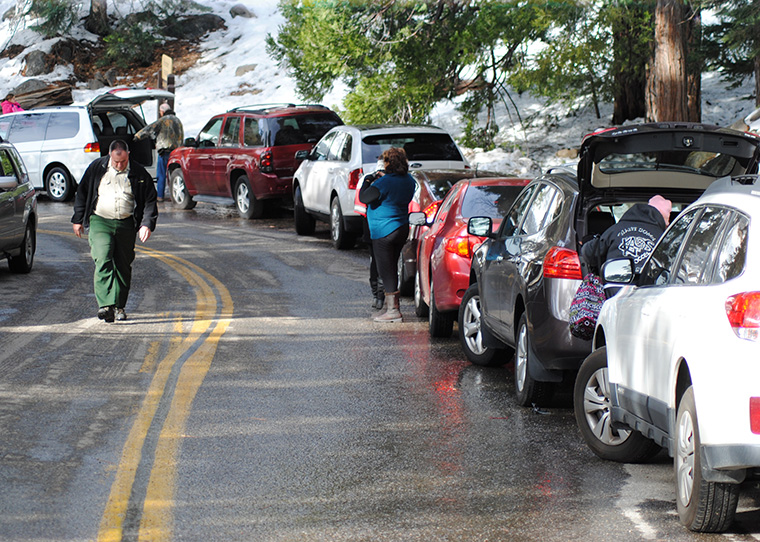
“We had to call for pumping of the porta-potties because they were overflowing,” said Trout. “People parked everywhere. Roland [Perales, site manager] had to ask to have cars moved so the pump truck could get in. And as soon as it was in, it got blocked again.”
Asked how the center plans to deal with future snow visitors, Trout said,”We have to be better prepared when the next snow comes, and have sufficient volunteers on hand to interact with the visitors, to explain about the trash cans and lead by example.” She explained when Perales started picking up trash and putting it in cans, some visitors began to help.
John Ladley, U.S. Forest Service local recreation officer, related similar trash and littering challenges at Humber Park. “This was a different group than we typically get up here, ones we have not seen before,” said Ladley. “This was a much messier group than the general public. They were not coming for the forest or the trails, just for the snow. And they did not seem to understand jurisdictional boundaries [public from private land].”
Ladley explained that most Humber Park visitors and trail users have understood the “leave no trace” ethos that has long characterized the San Jacinto forest and Idyllwild in general. “With this most recent group, there was a huge disconnect. There has to be some educational component, some user contact that helps visitors understand about respecting the environment.” When asked whether signs would help, Ladley said recent visitors had torn metal signs off posts within the park to use as sleds. He posited that having rangers and volunteers talk with visitors about respect for the forest might be more effective. The difficulty, he noted, is in having sufficient staff to deal with thousands of visitors unfamiliar with the mountain and its conventions.
Both Ladley and Trout recounted that truckloads of trash have had to be removed on each of the three successive post-snow weekends. Ladley said rangers have still not surveyed all impacted land, because of existing ice.
Amanda Allen, County Park’s Nature Center park interpreter, said a full commercial dumpster of snow-visitor trash had to be removed each weekend and that trash removal was the primary activity of her staff and volunteers. “The trails have been left filthy, even though we have dumpsters and trash cans,” said Allen. She also agreed that educating the public is necessary — about the “leave no trace” ethic, respect for the land and snow-visitor responsibility for putting trash in proper receptacles. “Posting signs is historically not as effective as you would hope,” said Allen. “You really need extra employees and volunteers, boots on the ground, to educate people to care about the space. There was such a disconnect between the [recent] visitors and the space. It was a losing battle because they had not been educated about littering. Seventy five percent of the snow visitors never came into the visitor center. They went directly into the snow.”
When the next big snow comes, Trout suggested, “We need to be there to greet them, be kind and welcoming, and show them what the rules are and what is expected.” Said Ladley, “I think it’s important we all keep talking about this. It’s a collective challenge for the town.”