Photo by Holly Parsons
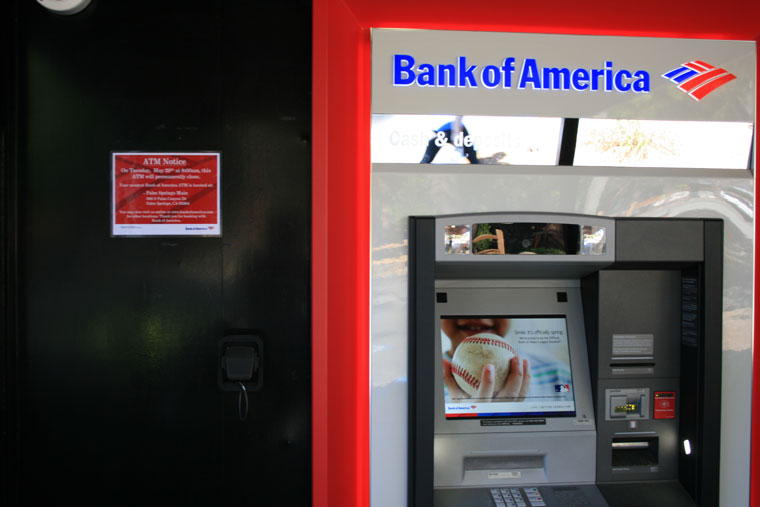
The red-laminated sign posted on the wall next to the Bank of America’s ATM located in the wall of BBVA’s Compass bank, reads, “ATM Notice – On Tuesday, May 29 at 8:00 a.m., this ATM will permanently close. Your nearest Bank of America ATM is located at: Palm Springs Main, 588 S. Palm Canyon Drive, Palm Springs, CA, 92264. You may also visit us online at www.bankofamerica.com for other locations. Thank you for banking with Bank of America.”
Notwithstanding the fact that the nearest BofA is actually in Hemet, the unilateral consequences of the decision to close versus immediately relocate the ATM in town, creates wide-ranging ramifications for personal and commercial account holders. Tourists’ availability to funds can be expected to impact local businesses and the decision also impacts the cost of doing business for all three local water districts.
The ATM’s closure forces BofA customers to drive a minimum of 40 minutes down winding mountain roads, in all manner of inclemental weather, to make payments, withdrawals or deposits in either Palm Desert, Hemet or Banning.
Additional customer feedback reports that the BofA ATM is often found empty by Sunday night or Monday due to the continuous cash needs of this community coupled with the influx of tourists making withdrawals. Upon inquiry, BofA media contact Colleen Haggerty mounted an investigation of ATM cash-out conditions, writing that “with the exception of an equipment failure which was quickly resolved in early March, our system reported no cash out alerts since 1/1/18.”
It appears that BofA has underserved local Idyllwild depositors by incrementally limiting access to services since it closed the branch; actions which represent significant customer service issues. Idyllwild Community and Idyllwild Chit Chat Bulletin boards on Facebook record combined responses to the news of more than 150 comments in 24 hours. Brent Sechrest wrote, “… without an ATM option in Idy I’ll probably close my account.” Bill Judkins: “The only reason we chose B of A was because of the ATM in town. Now we’ll have to reassess.” Laura Huff: “Nooo…I use the ATM regularly.” Kai Van Bodhi: “I have a BOA account and depend on that ATM for deposits. It would def. effect my business.” Marilyn Baker: “Need Bank of America in Idyllwild…big time…!!!.” Lindsey Oliver: “We use the ATM weekly for both personal and business use. The ATM up here is very convenient. If they remove the ATM they will lose our business, I’ll have to change banks.”
These reflective community concerns are mounting as news spreads, coupled with disappointment that BofA did not inform depositors directly.
Village Hardware Manager Larry Donahoo said, “When the branch was taken out many years ago, the manager came by the store and promised to keep the night deposit drawer; no added expense would be incurred. BofA would provide special deposit slips and a money bag for night deposits, no charge. A few years passed and they closed the night deposit. Now my staff drives 40-plus miles to Hemet, facing a dark parking lot with security concerns, to make deposits. Basically, BofA has forgotten their promises to Idyllwild; it’s a classic case of institutional amnesia.”
Jerry Holldber, general manager of the Pine Cover Water District, further pointed out: “With the removal of the large deposit drawer, our water district was unable to make deposits into our BofA accounts. This created the initial need for staff to drive all deposits off the Hill. We have since solved this problem in part. However, I view closure of the ATM will create hardship for Idyllwild customers in general; if our customers can’t easily make deposits, they may find it difficult to pay their water bill — every one doesn’t own a Smartphone.”
Many years ago, BofA maintained a branch in Idyllwild acquiring a significant percentage of commercial and personal accounts in the area. “Over 10 years ago, that branch closed,” remembers PCWD Office Manager Becky Smith. “Pine Cove Water was informed by letter when the branch closed that the day would come when the ATM would be removed,” Smith recalled. The branch closure slid largely under the radar because BofA maintained an ATM outside BBVA’s main door, initially providing night deposit and standard ATM services for its customers.
In retrospect, the initial act of closing the Idyllwild branch by BofA more than 10 years ago was the first breach of community trust; the second breach occurred when BofA removed the external, secured depository system for use by government, educational and commercial customers. The final act, removal of the ATM entirely, will complete the erosion of reasonable access to deposit funds and investment share disbursements.
“The Community Reinvestment Act (CRA), [enacted by Congress in 1977] was created to encourage depository institutions to service the banking needs of the communities in which they operate; specifically under-served rural communities,” said retired bank executive and Idyllwild resident Les M. Gin, a vice-president with Wells Fargo for 10 years, Chase for 15 years and founding president of the Asian Bank of Arizona.
Gin added “The CRA rating, which is administered by the FFIEC and FDIC, are essential to a bank’s overall viability when governing bodies evaluate their applications for mergers, acquisitions and branches; any breach, thereof, is considered a serious violation. In fact, the FDIC website invites community comments which can trigger the need for a bank’s review by the Board of Governors of the Federal Reserve System Board. Also, negative media publicity and public outcry emphasizing actions a bank is taking to restrict accessibility to depositor funds can result in an under-served community having their services restored,” said Gin.
The FFIEC website [https://www.ffiec.gov/cra] states: “The Council is a formal interagency body empowered to prescribe uniform principles, standards, and report forms for the federal examination of financial institutions by the Board of Governors of the Federal Reserve System (FRB), the Federal Deposit Insurance Corporation (FDIC), the National Credit Union Administration (NCUA), the Office of the Comptroller of the Currency (OCC), and the Consumer Financial Protection Bureau (CFPB), and to make recommendations to promote uniformity in the supervision of financial institutions.”
Idyllwild residents have long endured the rigors and limitations presented by the absence of a full-service national bank whose products include a vast number of ATMs, broad-spectrum international banking relationships, nationwide branch locations, a LAIF deposit program for California state water utilities and management of expansive investment portfolios. This is problematic for residents with diverse banking needs.
LAIF, the Local Area Investment Fund, is managed by California Treasurer John Chiang and his board to specifically enable California utilities the benefit of earnings from low-risk investments. LAIF does not accept deposits from water districts by mail.
Each of the local three water companies may perform online wire transactions into LAIF-chartered bank accounts, for no charge. The LAIF investment program had chartered eight U.S. banks and BBVA Compass is not on the list.
While the total combined savings deposits to LAIF by three water districts is small change to BofA, the state treasury may hold a collective expectation that participating LAIF banks, who reap significant income from participation, will support small constituencies such as Idyllwild by maintaining an ATM with night-deposit capability, at the very minimum.
It could be LAIF agrees. The disadvantage to the operation of local water districts appears to be of interest to Marc Lifsher, director of Communication for the California State Treasurer’s office responsible for managing LAIF. Lifsher said, he was “unaware of BofA’s intention to shut down in Idyllwild.” Lifsher went on record stating, “We recognize BofA has closed a lot of branches in the state, particularly in Northern California. Our banking unit is now looking into the restricted banking implication for Idyllwild’s water districts.”
In a follow-up conversation, Lifsher advised, “Bank of America stated they are offering water companies and commercial account holders free check readers.”
Fern Valley Water District General Manager Victor Jimenez said, “Our district elected to abstain from opening multiple bank accounts off the Hill in response to this hardship and in service of cost containment.”
Fern Valley Office Manager Jessica Priefer additionally disclosed, “Some years ago when BofA removed the large deposit drawer from the ATM, we were very inconvenienced by having to drive deposits off the Hill. We subsequently purchased a manual check reader. However, it’s time consuming to insert individual checks, and when coin accumulates, I’m required to drive the deposit off the Hill.”
Idyllwild Water General Manager Jack Hoagland acknowledged his district has similar issues that have been solved by opening alternative bank accounts on and off the Hill. “Subsequently, bank fees, ACH and wire transfer costs incurred don’t exceed $200 per month,” said Hoagland.
The Town Crier inquired of Haggerty as to how the bank justifies abandonment of the Idyllwild community of depositors cultivated over decades. She responded, “Your concerns have been escalated to colleagues [—] we are considering an alternate location for our ATM.”
A subsequent response from Hagerty reads, “I am following up on the other part of your inquiry around the ATM. We certainly understand the importance of maintaining a full-service ATM for customers, residents and visitors in Idyllwild. While we would prefer to keep the current ATM location, our lease there expires on May 31. The current property tenants then plan to locate their own ATM at that location. We do, however, continue to actively work on securing a new location, in town, for a new Bank of America ATM.” The Town Crier will give updates on this issue.
Meantime, Wall Street Journal reporter Rachel Louise Ensign reported April 16, 2018, that “Bank of America Corp. said Monday that a boost from the U.S. tax law and continued rising interest rates helped push first-quarter profit 30 percent higher, extending the string of better-than-expected results from the nation’s biggest banks. Quarterly profit at the Charlotte, N.C.-based bank rose to $6.92 billion from $5.34 billion a year ago. Per-share earnings were 62 cents; analysts had expected 59 cents per share. Revenue came in at $23.13 billion, up from $22.25 billion a year ago. Analysts had expected $23.06 billion.”